
Galician Wine Basics: Climate
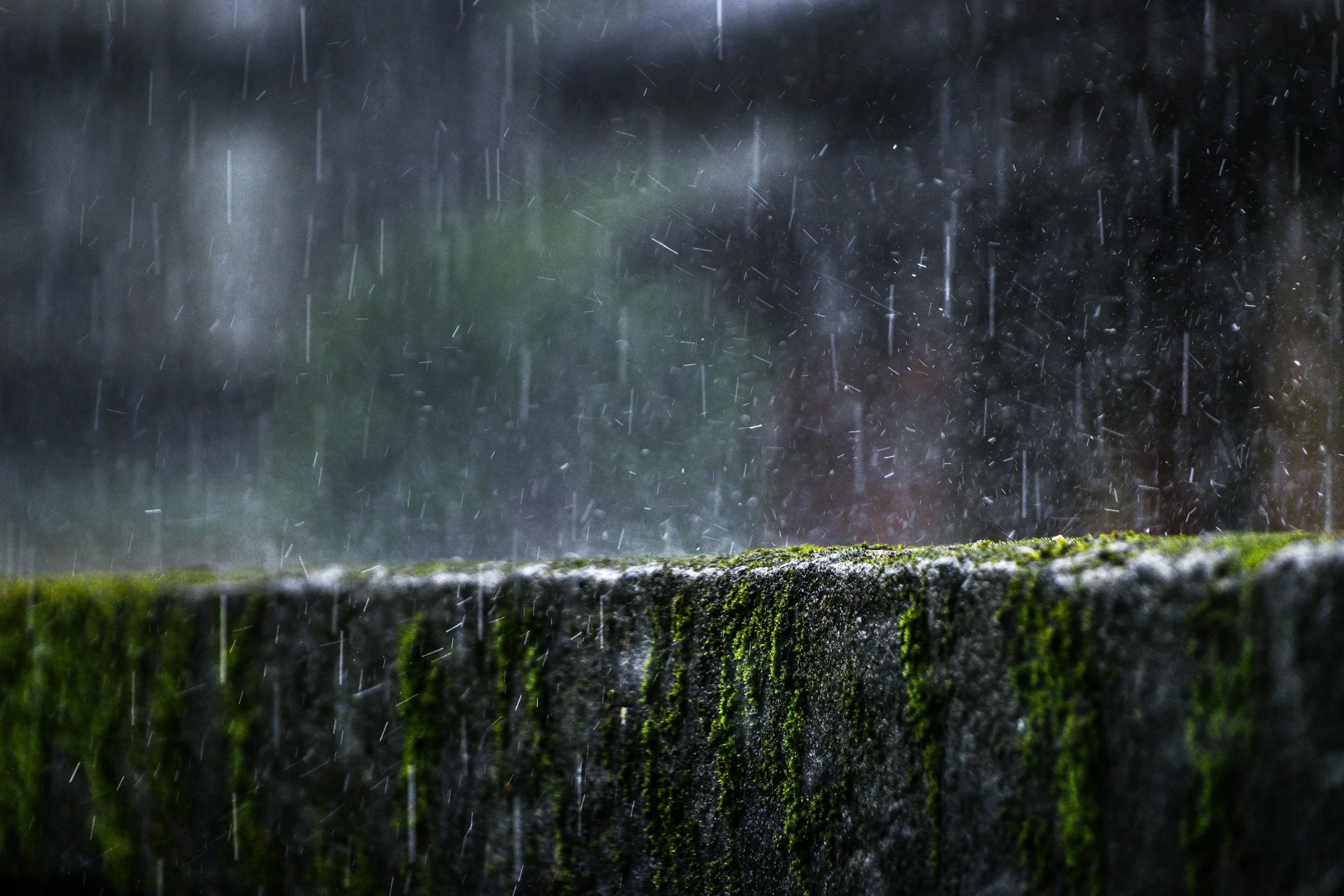
My Fair Lady got it wrong: the rain in Spain stays mainly in Galicia.
Most overviews leave Galicia’s climate at just that: cool, rainy, and influenced by the Atlantic. They’re not wrong, but if we dive a little deeper into Galicia and its wine regions, we find there’s a lot more going on.
The main factors influencing Galicia’s climate are latitude, location by the ocean, and topography. Galicia sits between 41° and 43° N, which puts it near the boundary where polar and tropical fronts meet. As these fronts change position over the course of the year, they create contrasting seasons: the polar front brings storms, rain, and cold weather in the winter, and the subtropical Azores High blocks the bad weather when it moves to the north in the summer, creating periods of mild warm weather without much rain.
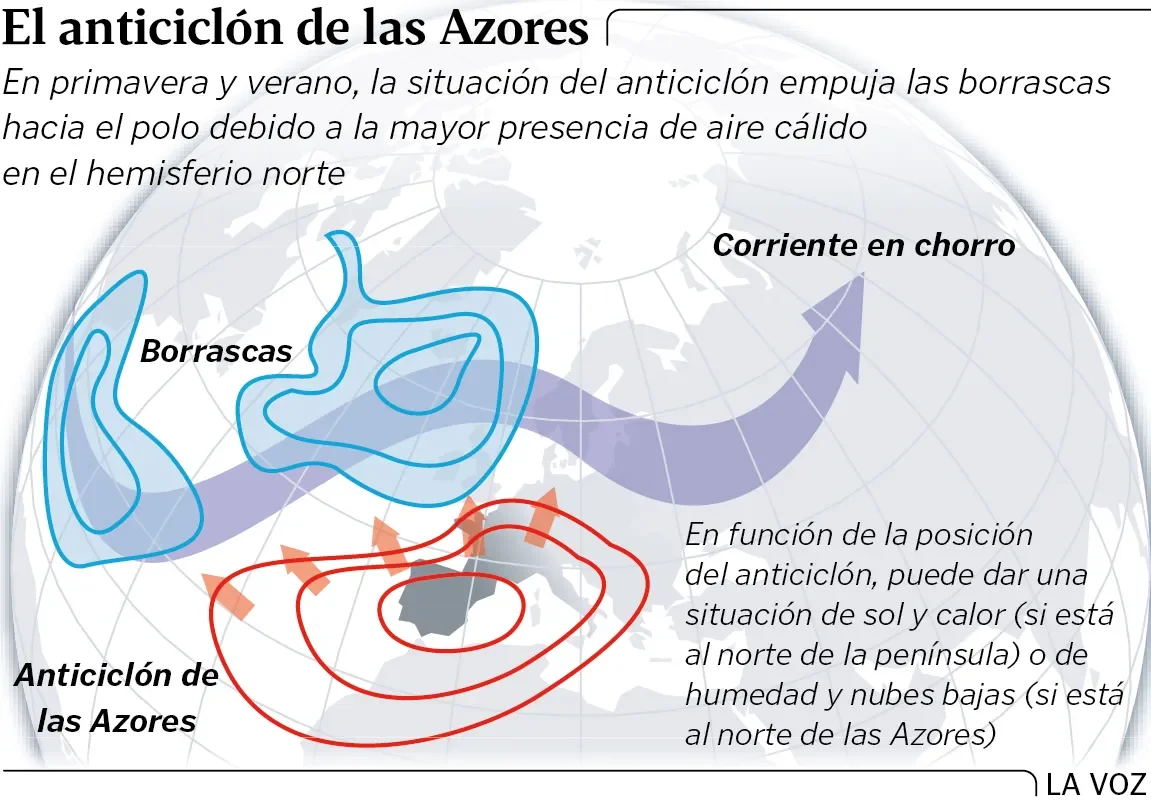
The Azores High: in spring and summer, the position of the Azores High pushes storms toward the North Pole due to the increased presence of warm air in the Northern Hemisphere. Depending on the position of this high-pressure system, it can cause sunny, hot conditions (if it’s to the north of the Iberian Peninsula) or humid conditions with low clouds (if it’s to the North of the Azores) — graphic by La Voz de Galicia
Surrounded on two sides by the Atlantic along the longest coastline of any autonomous community in Spain, Galicia is definitely influenced by the ocean. But its proximity to the Atlantic doesn’t always translate to lots of rain: although it shares features with other oceanic climates of Western Europe such as mild winters, cool(ish) summers, and a whole lot of rain, it stands out for long periods without rain in the summer, as well as an inland climate that’s very different from its coast.
In Galicia, the amount of rainfall at any place mainly depends on the shape of the land and how exposed it is to moist winds from the southwest. These winds reach the Rías Baixas first, so the rainiest part of Galicia is the coast and interior from Vigo to Fisterra. Here, yearly rainfall is more than 1,750 mm, and in some places over 2,500 mm. But head east of Galicia’s central mountain ridge and rainfall drops by a lot. In the driest zones, the rain shadow of the Dorsal Gallega mountain chain puts annual rainfall below 1,000 mm, giving the interior more temperature variation and putting its inland zones in Continental and even Mediterranean territory.
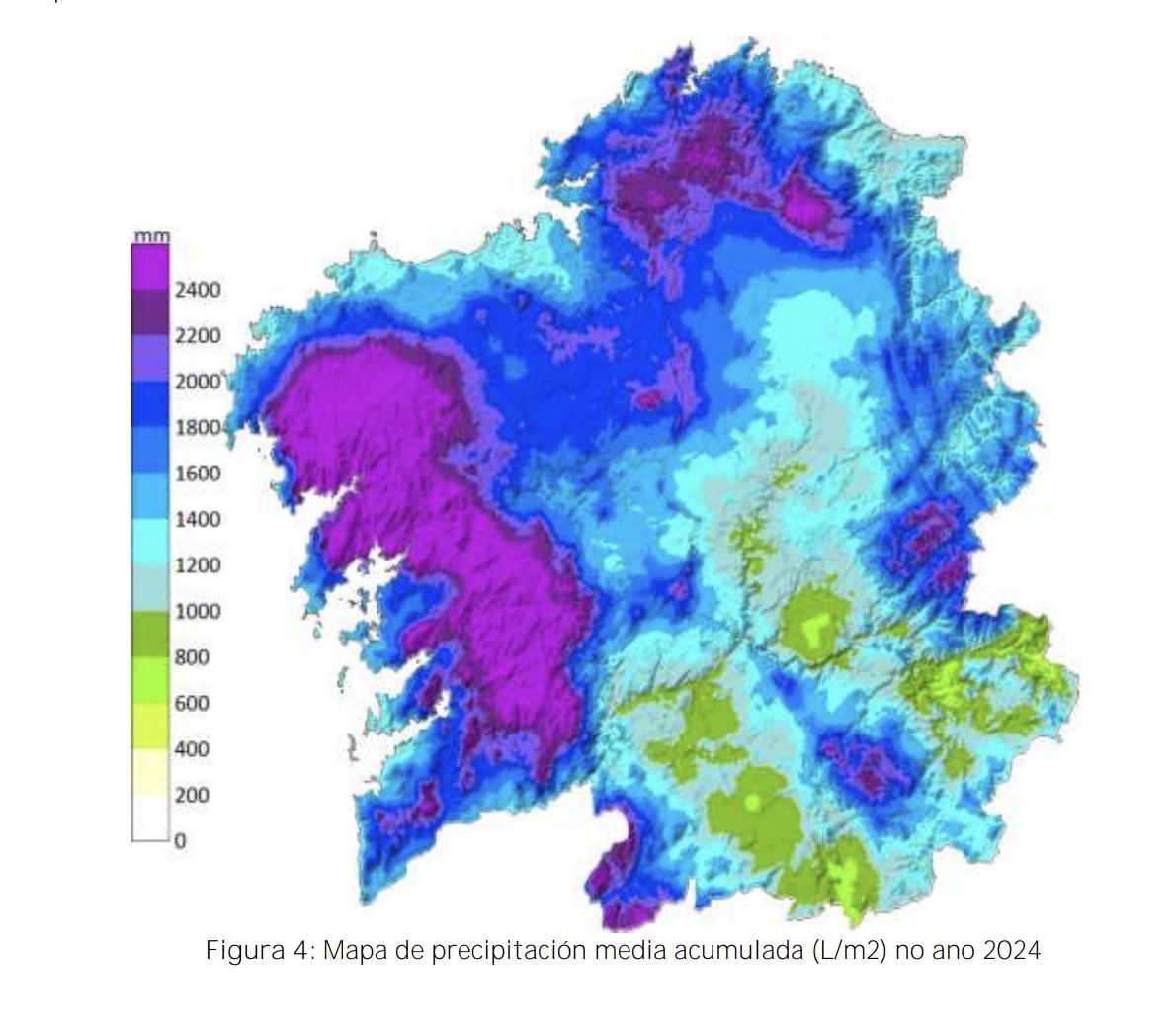
Map of average precipitation for 2024 (L/m2)
What about when it comes to wine? The varied climate and topography of Galicia’s main wine regions make its wines incredibly diverse in style and flavor, and also explain why its traditional grapes thrive where they do.
Coastal Rías Baixas has the most oceanic climate, with moderate temperatures that usually stay between 10º and 22º C and a difference of only about 13º between average summer and winter temperatures. Rías Baixas gets a lot of rain: on average, 1,600mm fall a year. Along with all that rainfall, the region gets over 2,200 hours of sunshine a year, so grapes have no problem fully ripening. Albariño’s early budding allows it to take full advantage of the long, mild growing season, while the cool, humid environment preserves its natural acidity and aromatic intensity.
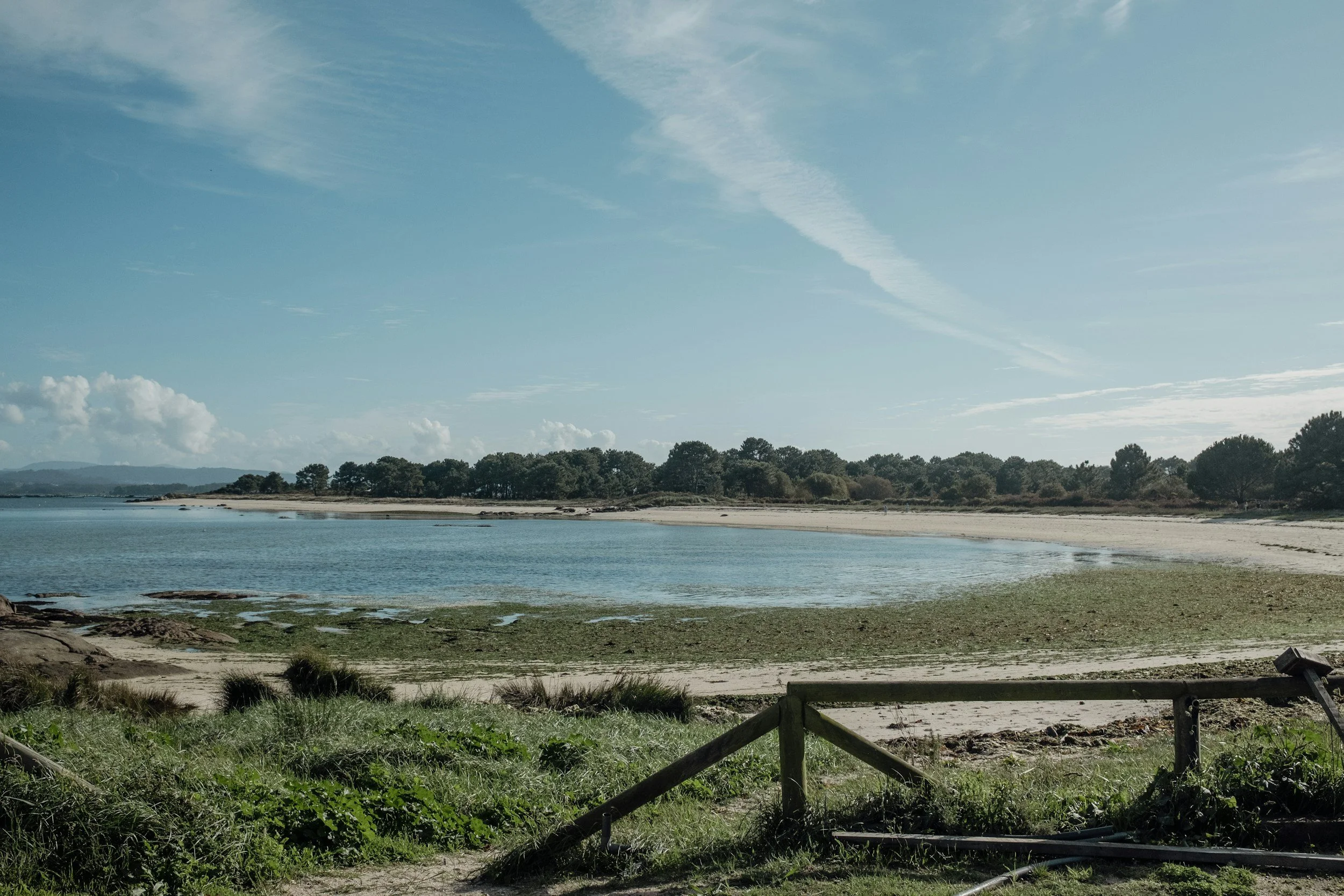
Moving inland, Ribeiro is located in Galicia’s “transition zone”, meaning its climate is a mixture of Atlantic influences (it’s only about 40km from the sea) and Continental/Mediterranean influences that comes from central Spain. The Serra do Suido and Testeiro mountains block most of the Atlantic weather, giving Ribeiro greater temperature contrasts between summer and winter and less rainfall than Rías Baixas. The Avia, Arnoia, and Miño river valleys create many different microclimates, and vineyards are affected by differences in orientations and exposures as well as any rivers or streams that flow nearby. Ribeiro’s warmer summers and lower rainfall makes it perfect for late-ripening varieties like Treixadura, Caíño Tinto, and Sousón, which require longer growing seasons.
If Ribeiro is Galicia’s climatic middle ground, Ribeira Sacra finds itself squarely in Continental-Mediterranean territory. Its location in and around steep river valleys gives it different climatic conditions from the surrounding territory marked by very high temperatures in summer, very low temperatures in winter, and little rainfall. Ribeira Sacra spans a couple of different mesoclimates, with cooler, rainer weather in the west around the Miño River, a Continental climate with Mediterranean influences in the Sil Valley, and an almost Mediterranean climate further east in Quiroga. In the Miño River valley, rainfall averages around 900mm a year with an average temperature of 14°C, while the Sil River valley is drier, receiving about 700mm annually, and the average temperature is 13°C. The steep, terraced vineyards along the river canyons maximize sun exposure, and early-budding grapes like Mencía benefit from the long growing season and warming effect of the rivers. Meanwhile, the extra boost of heat that stony terraces soak up during the day helps to ripen late-budding, late-ripening varieties like Brancellao and Merenzao.
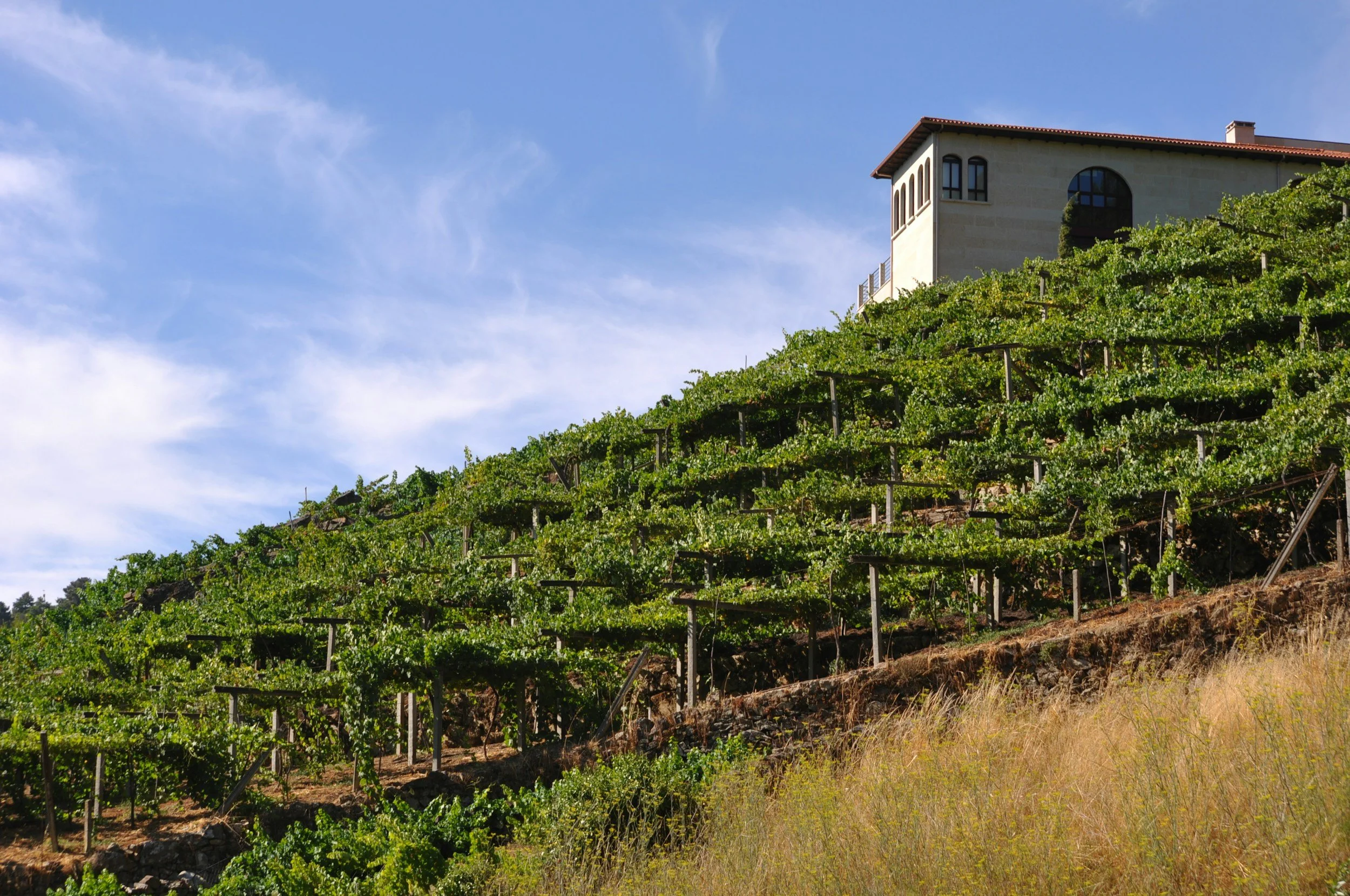
Valdeorras has a mostly Mediterranean climate with Atlantic influences here and there. The average yearly temperature is 11º C, with highs around 33º C in the summer and rainfall levels between 850 and 1,000mm per year. Within this general view, we can split Valdeorras’s climate into two similar but unique categories: an Oceanic-Mediterranean climate with hot summers, cold winters, and what are among the lowest rain levels in Galicia, and an Oceanic-Mountain climate found in higher-altitude areas, characterized by low temperatures and higher rainfall. Valdeorras’s climate supports its star grape, the early-budding, early-ripening Godello, with higher diurnal shifts allowing for full ripening while still preserving acidity.
Last but not least, Monterrei’s location in Galicia’s extreme southeast gives it a Mediterranean climate, with both Continental and Atlantic influences. Monterrei has hot and dry summers and cold winters, with diurnal shifts of up to 30º C during the growing season. But the climate is complex, with more Atlantic, Mediterranean, or Continental climate zones in different areas of the Támega River Valley or its slopes. Monterrei’s climate can be tricky for early-ripening varieties like Godello and Mencía, which can become overripe and jammy if growers leave them too long.