
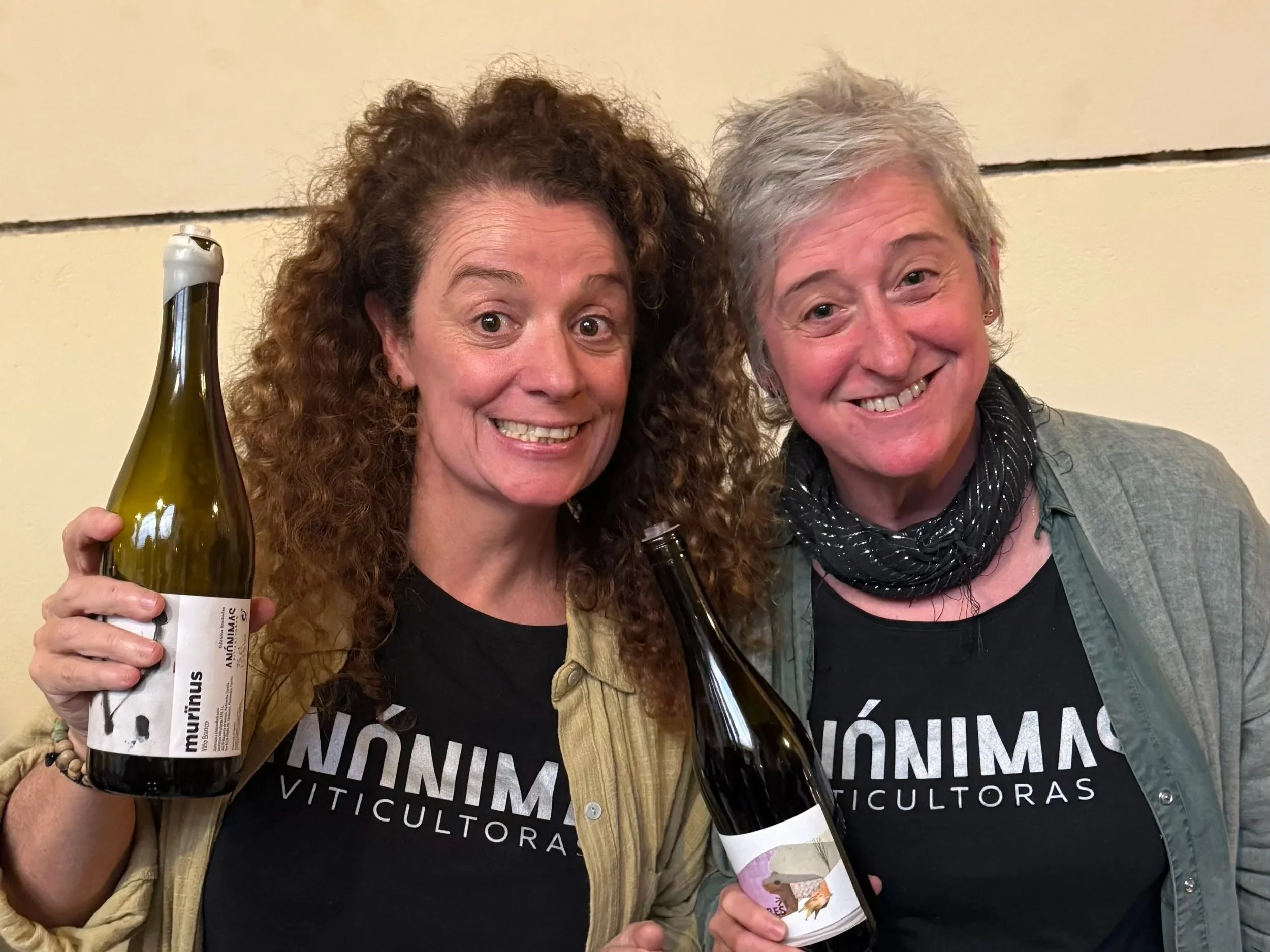
María Falcón (left) and Cristina Yagüe were doing things differently from the start. For one, rather than naming their project something about themselves or their families or what they hoped to accomplish, they decided to name their winery in homage to others. In 2016, they named their new winery project Anónimas Viticultoras, in tribute to the anonymous women who have always been the backbone of rural Galicia.
As if giving women’s role in the traditionally male-dominated world of winemaking the recognition and visibility it deserves wasn’t a noble enough calling, they also took it upon themselves to take a different path when it came to winemaking: amidst a sea of Albariño, they decided their debut wine would be a red, made from the native Caíño Tinto grape.
After making both red and rosé wines from Caíño, they expanded to Albariño, recovered vineyards in Ribeira Sacra to make Mencía, and also started working with Godello from Valdeorras. Today, they’re even one of three wineries in Rías Baixas who work with the native Ratiño grape.
Their approach is driven by experimenting: from putting Mencía through carbonic maceration or aging white wines in Palo Cortado barrels to aging wine in cocciopesto amphora—an ancient material used by the ancient Romans—they’re not afraid to push the limits of what Galician wine can do.
When I met them and tasted through their wines in March this year, I could barely get through to the table—it was that packed. It’s encouraging to see projects like these get the love they deserve from Galicians, and hopefully they’ll start getting some more recognition abroad. It’s winemakers like María and Cris, who push the limits of what a given variety, style, or region can do, that keeps Galicia evolving and ensures it stays exciting. And who knows: maybe they’ll inspire future anonymous grape growers and winemakers to finally step out of the shadows and start their own projects. We can only hope.
ANÓNIMAS — The Wines
Os Dunares Albariño 2024
Produced from small pergola-trained vineyard plots between 25 and 40 years old, planted on granite soils 400 meters from the sea. Grapes are destemmed and undergo cold pre-fermentation maceration. After pressing it’s fermented in stainless steel and remains on the lees for at least 5 months until bottling. A classic coastal Albariño expression with aromas of mandarin, fresh lime, and sea spray. Bright and refreshing, with lively acidity and a clean, classically Albariño bitter finish.
Os Dunares Tres Invernos 2021
Made in the same way as Os Dunares, but one third is aged in cocciopesto amphorae for at least 4 months, after which it’s blended with the original batch and aged for “three winters” (hence the name) in stainless steel. A more evolved expression of Albariño. Shows more oxidative complexity and texture, with a broader mouthfeel and a subtle bitterness that comes across as grip and phenolic structure rather than tannin. More savory and layered than the younger bottling.
Pedramogueira 2020 — Albariño 15% / Godello 85%
From a 35-year-old pergola-trained vineyard recovered by Cris and María in the village of Vilagarcía de Arousa, planted on granite soils 400 meters from the sea. Grapes are destemmed and the free-run must ferments in amphora, where it rests with regular bâtonnage until spring. Rested at least a year after bottling. Honey, ripe peach, and generally evolved fruit. The Godello brings a slightly wild, ripe melon note. Retains a beautiful line of acidity that keeps the wine fresh and balanced on the palate despite its evolution on the nose.
Murinus 2022 — 100% Ratiño
Sadly I didn’t get winemaking notes on this one! A textural, medium-bodied wine with honeyed notes and a soft, rounded palate. Delicate richness balanced by freshness, finishing short and clean.
Catro e Cadela 2024 — Godello 100%
Made from Godello sourced from from south-facing 20 to 60-year-old vineyards planted on slate soils at 500 meters on the right bank of the Sil River. After a manual selection, grapes undergo a cold pre-fermentation maceration. Only free-run juice is used. One quarter ferments in new French oak barrels, where it ages for 5 months and is then blended with the rest of the wine, followed by aging on the lees in stainless steel tanks. Shows ripe orchard fruit, depth, and nice freshness. Nice combo of fruit richness with vibrant acidity.
Dunaria 2024 — Caiño 85% / Mencía 15%
Anónimas’ first wine, the grapes for Dunaria come from old plots of Caíño Tinto and Mencía a few kilometers from the sea. Grapes are destemmed and pressed manually, and only the free-run juice is used. After a slow fermentation, the wine ages on its own lees during autumn, and later ages on fine Albariño lees in stainless steel tanks until the following spring. A distinctive rosé with punchy aromas of strawberry candy and bright red fruit. Intensely saline and mineral, with juicy pink fruit, energetic acidity, and coastal freshness.
Os Dunares Tinto Mencía 2022 - Mencía 95% and Caíño 5%
Vines come from the 35-year-old Carramachelo vineyard in the village of Cambados, where pergola-trained vines are planted on Rías Baixas’ typical decomposed granite soils. Grapes are destemmed and ferment in large vats where they ferment for 3 weeks with gentle daily punch-downs. After a manual pressing, the wine rests in stainless steel for 4 months and in bottle for a minimum of 6 months before release. A light-bodied, low-alcohol red at 10.5%. Green herbal notes, firm tannic structure, and definitely a lot of rusticity. Fresh, lean, red wine typical of Rías Baixas.