
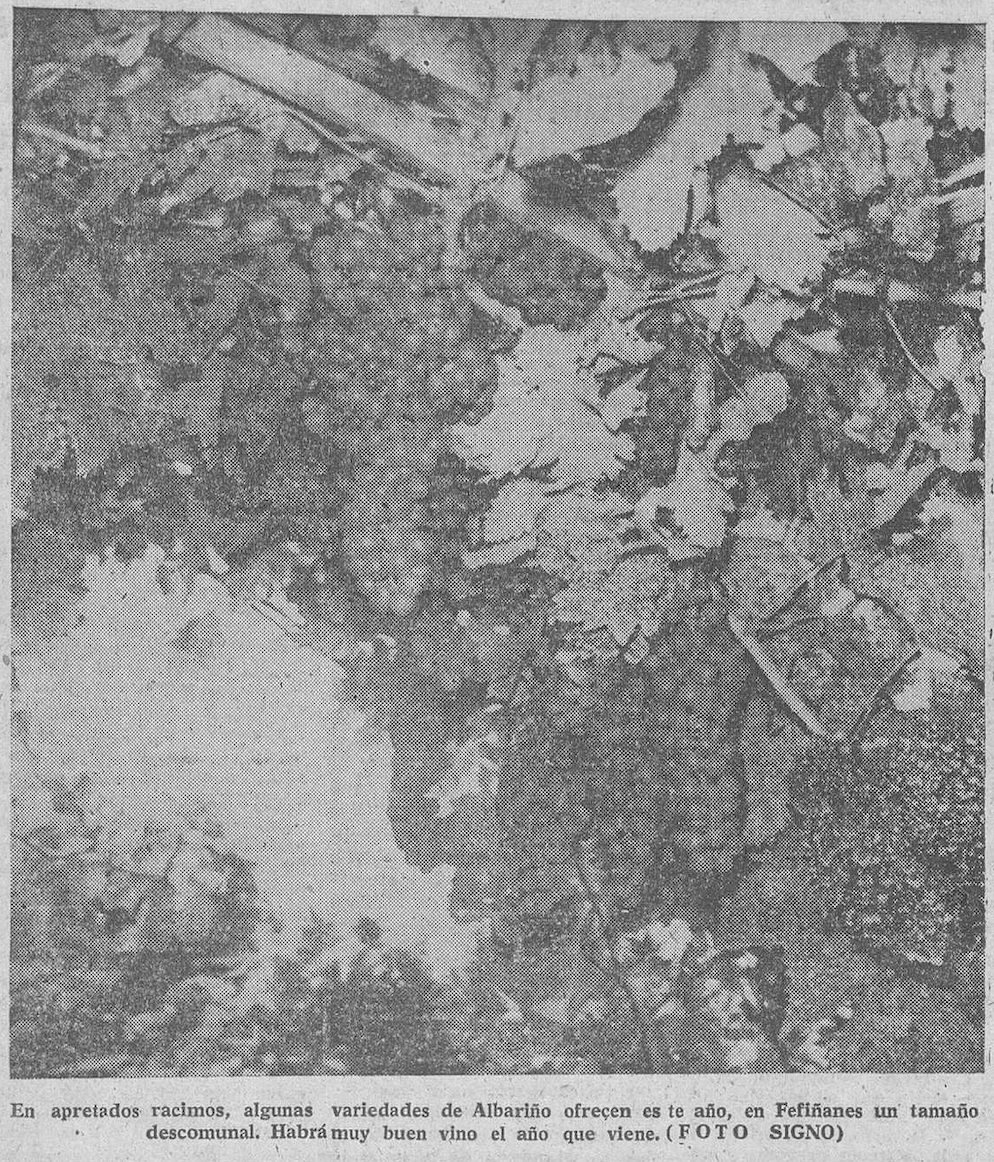
In celebration of August as Albariño month here at The Wines of Galicia, I wanted to take a dive into the Albariño archives. I’ve spent a lot of time looking through old Galician newspaper records, and I want to share two articles with you. The first is an excerpt from a piece published in September of 1960, about Albariño around the Salnés Valley, and the second is an interview from August 1962 with Bernardo Gil y Armada, owner of the Pazo de Fefiñanes (which makes an eponymous Albariño today). Things like these are essential for understanding the story of Rías Baixas Albariño. They give us a window into how people thought about wine at the time, and they let us see firsthand the process of how one grape began to take over the region.
What’s really fascinating to me is that the first journalist actually flirts with the concept of terroir, or at least the idea that some wines were different because they grew in different soils. It’s a message that’s become diluted over years of a very effective marketing campaign that’s linked a grape to a region, but left out some of the nuances in its cultivation and production.
The towns named in the article are still some of the best places to grow Albariño today. Based on historical tradition (at least the last 60 years) and the wines they put out today, you could make an argument for elevating some of these places as the “Grands Crus” of Rías Baixas.
Not that everyone would necessarily be on board with that. As the Albariño boom has gone on, people have planted Albariño wherever they could, but not necessarily where they should. Driving around Meaño, Rodri Méndez pointed out that half the town used to be planted with wheat or corn—not anymore. The Albariño train has meant people planted the grape in what used to be potato fields, along riverbeds, and in easily flooded areas—not great for a grape that thrives in easy-draining soils.
At the end of the day, looking at history gives us important context, especially when we talk about a wine region that’s younger than the Sony Discman. I hope you’ll find these as interesting as I did—not only as a reminder of how far Rías Baixas has come, but also as a glimpse of what it could yet become.

A WINE THAT DOES NOT LEND ITSELF TO ADULTERATION
We have heard it said at every festival and competition held in this noble town: the vine that produces the great wine of Cambados was brought from France by a group of monks. And here it remained forever, for Albariño continues to grow in importance with each passing day.
This wine is made from a small grape of extraordinary delicacy, one that requires great care and attention. It carries the influence of the Umia River and the strength of the sun, from which it takes its golden color. It also possesses the distinctive aroma of the lands of Salnés.
The areas of greatest production are Tragove, where Gómez Pomares has his wineries, and Padrenda, the wine-growing domain of Don Ernesto Zárate and Don Antonio Garela. The wines made by the parish priest are especially renowned. Indeed, the wines of the priest of Meaño are also exceptionally delicious. And when speaking of those from Castrelo, at the very mouth of the Umia River—whose waters might at times seem as golden as Albariño itself—one cannot fail to mention the winery of Manuel "O Músico" ("The Musician"). The vineyards of Simes, Dorrón, and Lores also enjoy well-deserved fame. All of these wines are delightful, whether produced by the sea or farther inland in the mountains.
The harvest increases every year, but one should not imagine that it is especially abundant. Because of the grape's delicate cultivation and winemaking process—from the moment it grows on the vine until it reaches the cellar—production never reaches extraordinary quantities. Nevertheless, it is sufficient for Albariño to appear triumphantly on the finest dining tables whenever the occasion arises.
Some growers harvest as much as two bocoyes [bocoy = a large wooden wine cask, typically holding about 500 liters], but the average yield is about seven arrobas of fourteen and a half liters each. Albariño is always at its best, whether kept in wooden casks or in bottles. However, consumers generally prefer it bottled when it has aged, and served in a fine porcelain cup when it is young.
For several reasons it is, in a sense, an expensive wine, but people gladly pay for the outstanding qualities of this Albariño from Cambados. Here in Cambados, a three-quarter-liter bottle sells for twenty to twenty-five pesetas[about €7 today].
Within its class, the different styles of the wine vary considerably, yet they always retain their own distinctive character. One thing we can say is that Albariño "has no friends"—that is, it does not tolerate blending or chemical adulteration. It may be slightly sparkling, firmer, or more acidic depending on the soils where it is grown, but it will never disappoint even the most demanding palate by being mixed with other wines.
We verified this ourselves in Cambados, O Grove, Portonovo, and finally at Moisés's establishment and Román's bar in Sanxenxo, another of the towns where Albariño has acquired a preeminent identity.
FROM CAMBADOS TO THE WORLD, A SMALL TORRENT OF ALBARIÑO IS BORN EACH YEAR AT TORRES DE FRAGUA
Many years ago—almost thirty, which is practically a lifetime—Don Bernardo Gil y Armada, one of the descendants of the distinguished family established in Fefiñanes, set out for Germany to devote some time to studying the production of Rhine wines, which bear a close resemblance to the Albariño wine of Cambados.
Don Bernardo, who produces and ships his Torres de Fragua white and rosé wines to some of the world's finest hotels and restaurants, is regarded as the man who knows wine in Cambados. Everyone knows it; everyone says so there, with admiration and deep respect for the technical knowledge that has enabled him to elevate and make famous throughout the world this unique product of the region—a product from which others have not been able to obtain the highest degree of excellence.
"Making Albariño," he tells us, "is something very personal. Unfortunately, there are not enough trained specialists to achieve the best possible results in terms of consistency, purity, and quality. It certainly requires more care than other wines, but only at the beginning, during clarification, because afterward it is actually more resilient."
Is there much production?
"Albariño accounts for only about one to five percent of the vineyards in this area. That covers the region from Vilagarcía to Sanxenxo, and from Castrove to the sea—the entire Salnés Valley."
Is this a unique grape variety?
"It has very well-defined characteristics: small, compact clusters and very sweet grapes. Today it is certainly a unique variety."
And its origin?
"People say it came from France, brought by the Monks of Cluny. Who really knows?"
When is the ideal time for the harvest?
"Around the middle of September. When the bees begin gathering nectar from the grapes, they're ripe."
What are your secrets as a winemaker?
"There are no secrets. The important thing is to take great care in preparing and cleaning the containers, to harvest the grapes at exactly the right moment, to rack the wine at the proper times, and to ensure good clarification."
How does this wine age?
"Very well. I've carried out every kind of experiment, with highly satisfactory results."
And how is it selling?
"Very successfully. Our Albariño can be found in Madrid and Barcelona, in London, Mexico, New York... Always, of course, in very select establishments, because production is limited and quality is the only thing that matters here. That's what has always interested me, which is why we've never advertised this wine, nor have we had representatives or salesmen. It earns its place in the market on its own merits."
What is your annual production?
"Between fifteen and twenty thousand bottles of each type. There are even recommendations required in order to have certain orders filled."
We know that what Don Bernardo says is true.
Before taking our leave, we encourage him to continue doing all he can to improve the quality of Albariño throughout the region by explaining to growers what they need to know and by encouraging them to organize into a cooperative so they can produce wines of consistent style and flawless craftsmanship.
The hope remains that this goal will one day be achieved.
—J. M. Signo