Like Watching History Unfold in Real Time
Driving through Portonovo, itself a town that plays second fiddle to glitzy, celeb-magnet Sanxenxo next door, you’d never notice A Curva if you weren’t looking for it. One of the best places to drink wine in Rías Baixas is tucked under a hill in a curve in the road across from Portonovo’s marina. I’ve only been in Galicia for five hours, but I’ve met up with Rodri Méndez and his wife, Ari, to taste through the lineup of his wines over lunch. When we arrive, A Curva is just opening, and owner Miguel Anxo Besada greets us. He and Rodri go way back to the early days of Forjas del Salnés, when he was one of Rodri’s first supporters.
Rodri founded his winery, Forjas del Salnés, in the early 2000s, but his family ties to wine go back further. His grandfather, Francisco Méndez, was a blacksmith and grape grower who helped to found DO Rías Baixas with Rodri’s uncle, Gerardo Méndez of Do Ferreiro. Another cousin, Pedro Méndez, lives nearby and has begun making wine outside the DO under his own eponymous label.
I’m excited - it’s been four years since I’ve visited Rodri and tasted the full lineup of wines. But as we sit down on the patio, an argument breaks out. Rodri wants me to order. I tell him he knows the menu the best, he should order. He insists. Neither of us will budge. Finally, we appeal to Ari, who breaks the tie. She and Rodri confer with Miguel Anxo, who disappears inside.
As we wait for the first plates to arrive, Miguel Anxo brings us the 2025 vintage of Leirana, Rodri’s flagship Albariño. From the start, the raw materials and winemaking announce that these aren’t just any Albariños. Grapes from some of the oldest vines he farms go into the entry-level cuvée, which ferments and ages—80%, in 2025— in foudre. It’s still young, but its ripping acidity and saline, peachy backbone make me confident it will age for years to come.
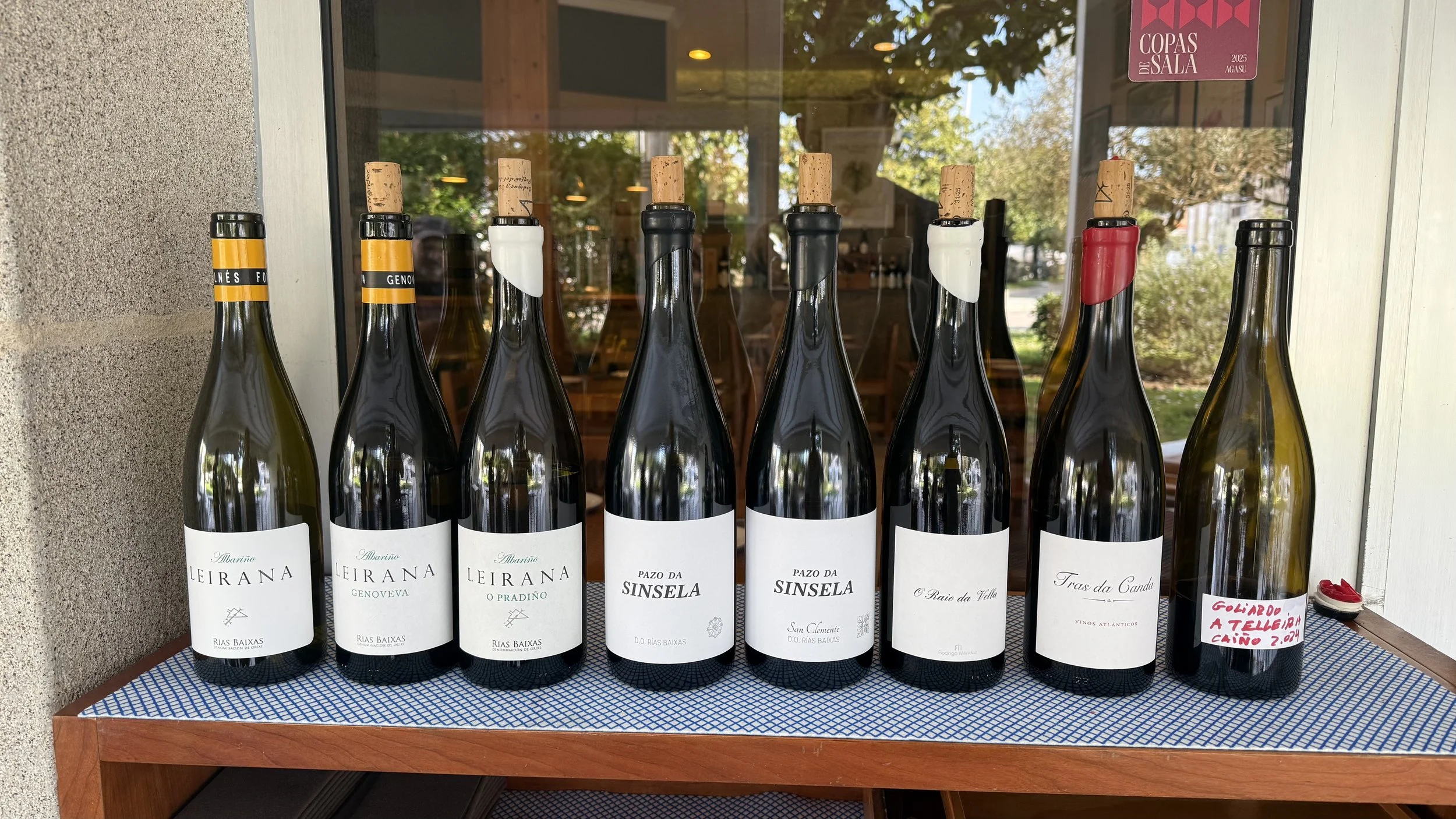
The lineup at lunch
We continue with the 2024 vintage of Finca Genoveva Albariño, made from a single plot of vines planted in the 1860s. It opens beautifully with a nose of mussel shell and lime candy, with a ripe, concentrated, almost honeyed note on the palate. Like the majority of the wines we’ll taste, this bottling is entirely aged in foudre. That isn’t normally the case in stainless steel-dominant Rías Baixas, and it certainly wasn’t always the case with Rodri. His winemaking has evolved away from stainless steel since he started, toward foudres, and also toward letting the idiosyncrasies of each plot shine through.
“It’s not about minimal intervention, but about learning how to intervene.”
He tells me that when he makes a change, it’s with the goal of improving. This can work against him sometimes. He feels that sommeliers tend to have a vision of him based on what he was doing or how the wines were presented to them at the time they first tasted them. It's important to him that people know that he’s constantly reinventing himself. “It's not about minimal intervention,” he insists, “but about learning how to intervene.”
Exactly what that intervention looks like is subject to debate. Like many Albariño producers, Rodri rejects malolactic conversion, which he believes strips wines of salinity and minerality. But unlike most of his peers, he keeps the wines on both the gross and fine lees, relying on foudres to soften the reduction that can result. According to the older generations, he tells me, the gross lees were known as a nai do viño, or “the mother of the wine”. In his mind, racking them off takes something away from the wine.
But for the most part, Rodri prefers to keep everything pretty similar between the different wines, so the parcels can speak—even if that doesn’t immediately resonate with the wine-drinking public.
“People aren't used to drinking the Albariños we’re making now,” he says. “They’re used to drinking wines from a blend of parcels, where the winemaker says ‘I do this to the wine, or I do that to the wine.’” As winemakers have gotten so technically adept with Albariño, he explains, there's a tendency to define wines by their process, whether that’s cryomaceration or stirring the lees or using barrels. But in his opinion, we should really be talking about terroir.
Consider Meaño, he says: in a six-kilometer radius, there are so many different wines that all taste different. “People talk about winemaking,” he says, “but they should be talking about vineyards and soils. The future is letting the place speak for itself.”
He names a few producers who are doing this: his cousin Manu Méndez, now the winemaker of Do Ferreiro, who has been making three soil-based wines for a decade now, or his friend Chicho Moldes of Bodegas Fulcro, who’s been exploring soils in wines like Nas Dunas, just a short distance from the O Pradiño vineyard.
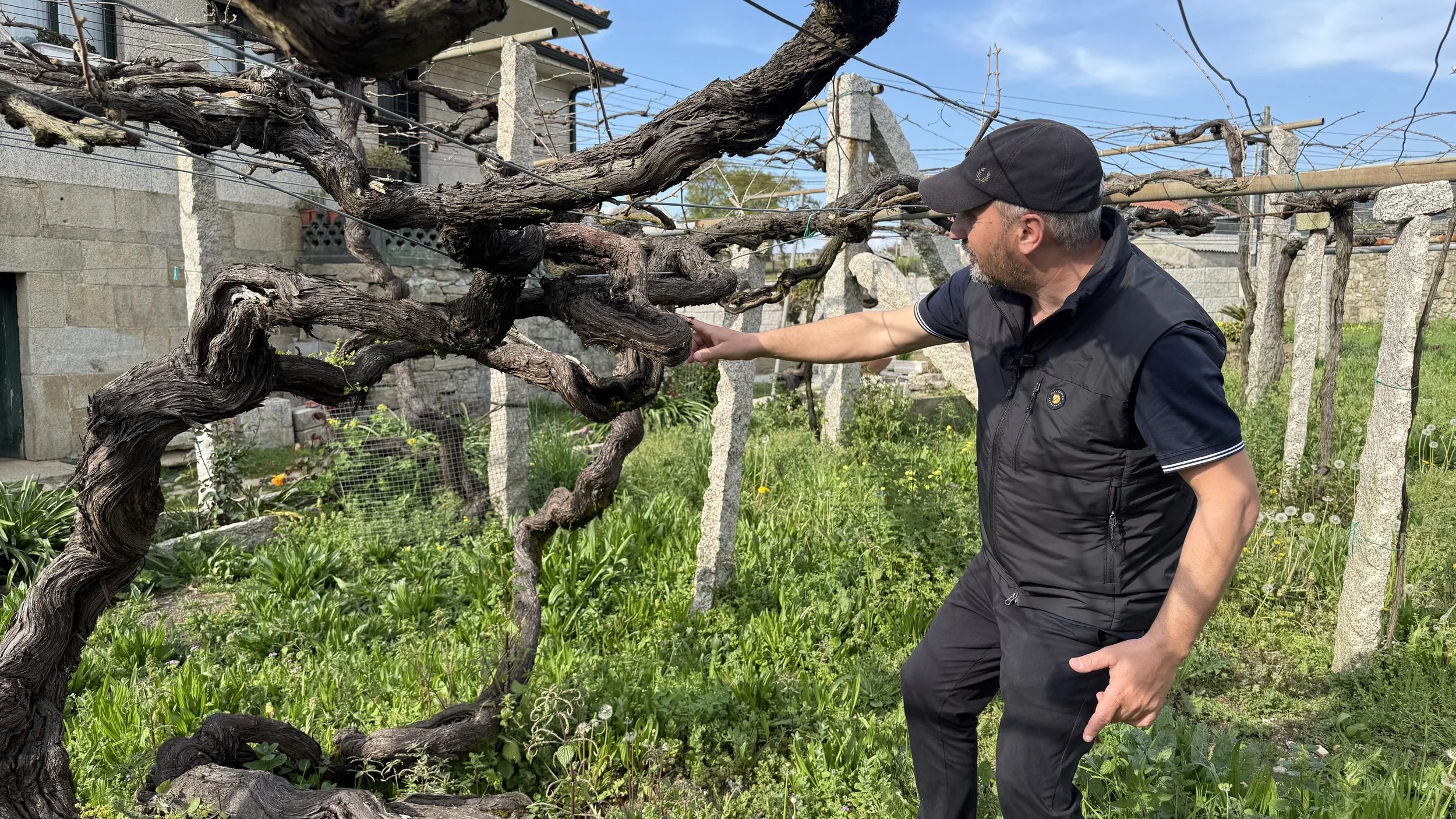
Rodri with an old vine of Albariño
As I taste, I mention that one of the Caíños is a little pyrazinic—not a bad thing, by the way, just my own tasting note. For a split second, an expression that I can’t quite read flashes across his face. But then he tastes the wine again. Another imperceptible change. “You know, it does have a little pyrazine,” he says to Miguel Anxo, who agrees. And then, almost to himself: “but the wines have gotten so much better.”
And it’s true: all the wines, especially the reds, have improved by leaps and bounds since I last tasted with him in 2022, and by lightyears since the early days of trying to recover red wines in Rías Baixas. When they first began to work with red varieties, Rodri says, they thought any lack of alcohol or greenness had to do with unruly varieties like Espadeiro, Caíño, or Sousón. But as it turns out, viticulture, not the variety, is the defining factor. The improvements in the wines don’t have much to do with anything he’s doing in the winery, but rather with increased vigilance in the vineyard.
Where before he had a short harvest window and limited labor, they now organize the harvest of the red varieties in multiple passes, to give bunches that might be a little green on the first pass more time to ripen. This takes a lot more time and a lot more organization, “considering we might only pick three bunches in one of those passes,” he tells me. Ari is in charge of marshaling the forces to make this happen. I ask if their two sons are involved and the two exchange a look. “Little by little,” Ari laughs.
But this new method of vineyard management has definitely made for a style of wine that I personally prefer. There are less overtly green notes and more high-toned, crushed violet aromas on the nose, with plenty of lip-smackingly fresh red and black fruit. They’re firmer, riper, more muscular than most of what’s out there.
These are not typical Rías Baixas reds. But in fact, no wines being made today are, because nobody knows what red wines from Rías Baixas are supposed to taste like. While it’s true that red wines dominated for most of the region’s history, growers didn’t have the viticultural knowledge or resources at their disposal that allows Rodri to be so precise, and the ancestral winemaking took place mostly in chestnut barrels rather than the oak foudres and barrels in use today.
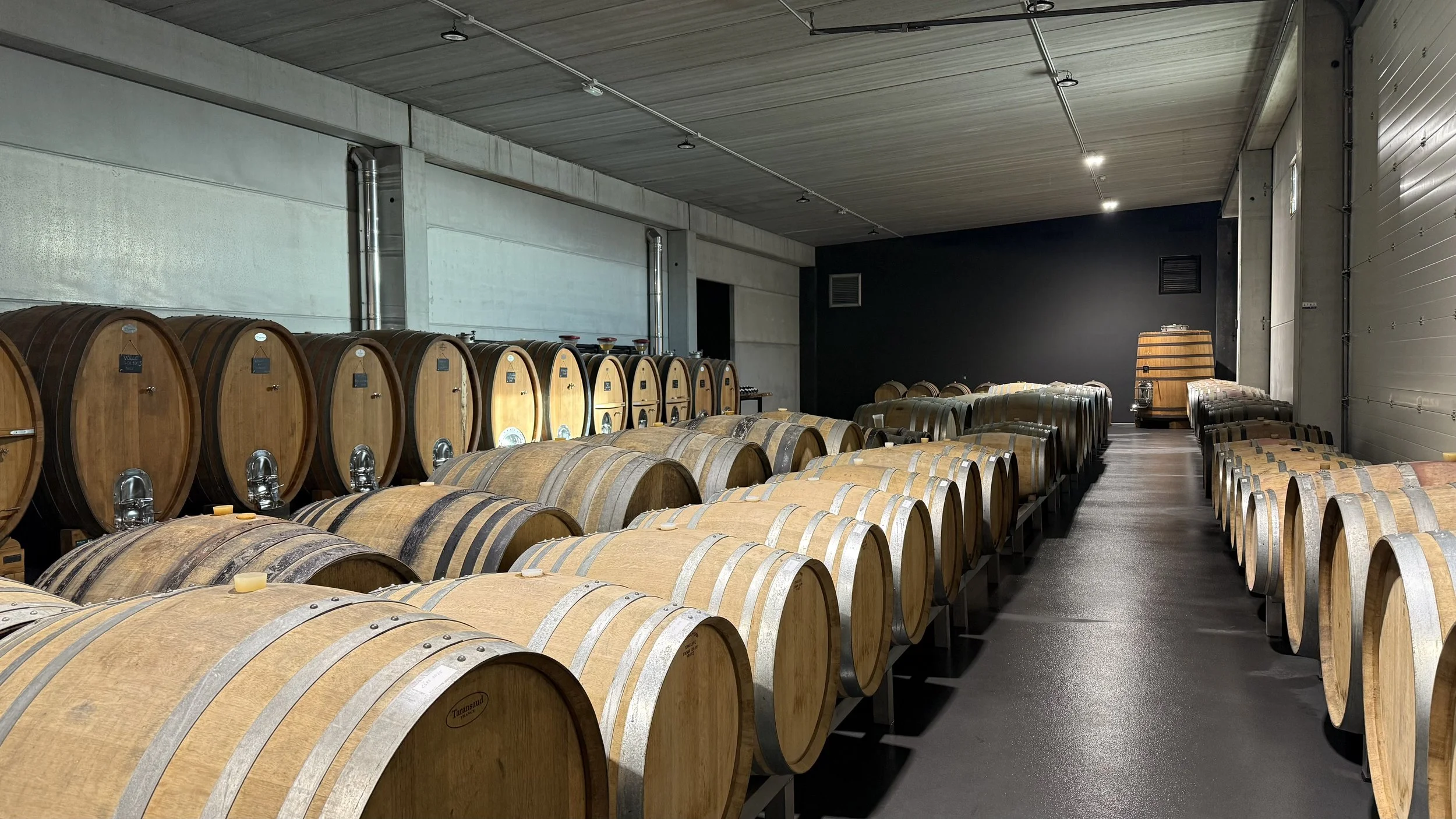
Inside the new winery in Meaño
I bring this up to Rodri and Miguel Anxo and they light up. Yes! It’s like we're watching history unfold in real time, they exclaim. “We're watching an experiment play out. We're watching these wines get better,” Rodri says.
After lunch, Ari drives us back to Meaño. On the way, their son Raul calls: can they hurry up? He has a soccer game to get to. She drops us off at their house, and we head out to visit some vineyards, where over the course of an hour Rodri shows me some of the towering old vines he works with, as well as a new, high-elevation plot where he keeps a flock of sheep, two cows, and a mule—part of his dream to return animals to the village.
After that, it’s off to the newly-built winery, where we taste what’s currently in barrel. Before I have to leave, Rodri shows me his private cellar, which still has the hooks where his grandfather used to butcher pigs hanging from the ceiling. It’s filled with wines from the last 20 years of Forjas del Salnés, wines from other top Rías Baixas producers, old Rioja, Burgundy, Riesling… and a surprising amount of wine from Rodri’s good friend, Raúl Pérez. “I have more of Raúl's wines than he does,” he says with a wink.
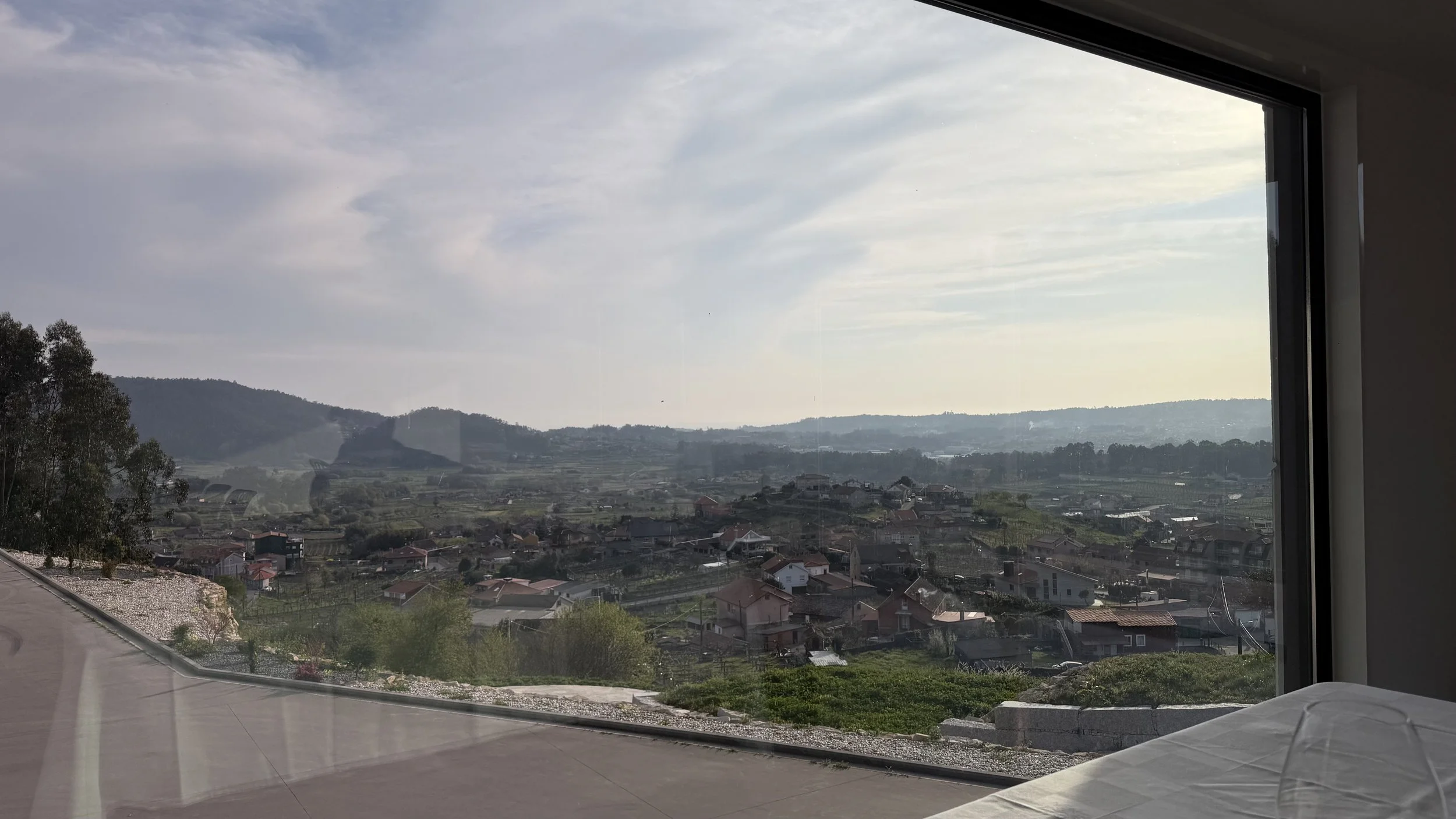
He picks out a 2005 María Luisa Lázaro, the first vintage of an Albariño named for his grandmother and only made in the best vintages. To date, he’s only made it in 2005, 2013, and 2019. We bring the bottle back to the winery and open it in front of a picture window that looks out over the village of Meaño and the valley beyond. The wine has evolved beautifully: it’s almost entirely tertiary in profile, layered with TDN/petrol notes alongside hay and herbs. Somehow it smells like the golden hour we’re watching from the window.
This is one of the oldest Albariños I’ve tasted. I say it’s great. Rodri says the acid isn’t quite as integrated as he’d like. “I'm very self critical,” he says. I tell him he has nothing to worry about. But his attitude strikes me as a good place to be, philosophically. Rías Baixas isn't in a place to rest on its reputation, at least not yet, and its best producers are working toward an ambitious goal: wines that speak more clearly of place, that might only fully reveal themselves years later. With that in mind, after our day together, Rodri’s restlessness feels inseparable from the evolution of the region itself. The most exciting wines in Rías Baixas are still to come.