
If Rome hadn’t already laid claim to the title of Eternal City, Santiago de Compostela would definitely be in the running. But rather than being the seat of Virgil’s “empire without end,” Santiago feels more like a David Byrne lyric: “same as it ever was”.
Every time I visit, I’m struck by the city’s unchanging nature, but also how little its ancient streets show their age. Rather than being a museum piece, Santiago is the backdrop to the latest episodes of daily life—for good or for ill. As someone whose country is approximately three adult lifetimes old, I don’t think I’ll ever really get over the fact that a bunch of 19-year-olds get drunk and pee on 12th-century buildings at three in the morning.
On the last day of my most recent trip, I took a morning walk from my hotel through the old city. I descended past one of the bagpipers who play from dawn until dusk in the archway of the Pazo de Xelmírez, and ended up in the Praza do Obradoiro, Santiago’s main square. A light drizzle fell on the people huffing and puffing their way to work, hugging the cathedral walls and avoiding the recently-arrived pilgrims taking photos of each other and celebrating the end of their Camino. As the cathedral bells struck three quarters of an hour, a school group came tumbling around the corner, full of laughter and excited chatter and high-pitched complaints.
I was reminded of the single greatest homage to the Galician capital, an essay published in 1983 by Gabriel García Márquez called “Viendo Llover en Galicia” or “Watching the Rain in Galicia”. Quoth Gabo:
“[Santiago de Compostela] imposes itself immediately, complete and forever, as if one had been born in it. I have always believed, and still do, that there is no square in the world more beautiful than that of Siena. The only one that has made me doubt is that of Santiago de Compostela, because of its balance and its youthful air, which does not allow one to think of its venerable age, but instead seems to have been built the day before by someone who had lost all sense of time. Perhaps this impression does not originate in the square itself, but in the fact that it is—like the whole city, even in its farthest corners—to the very soul a part of everyday life. It is a living city, taken over by a crowd of cheerful and boisterous students who do not give it a single respite to grow old.”
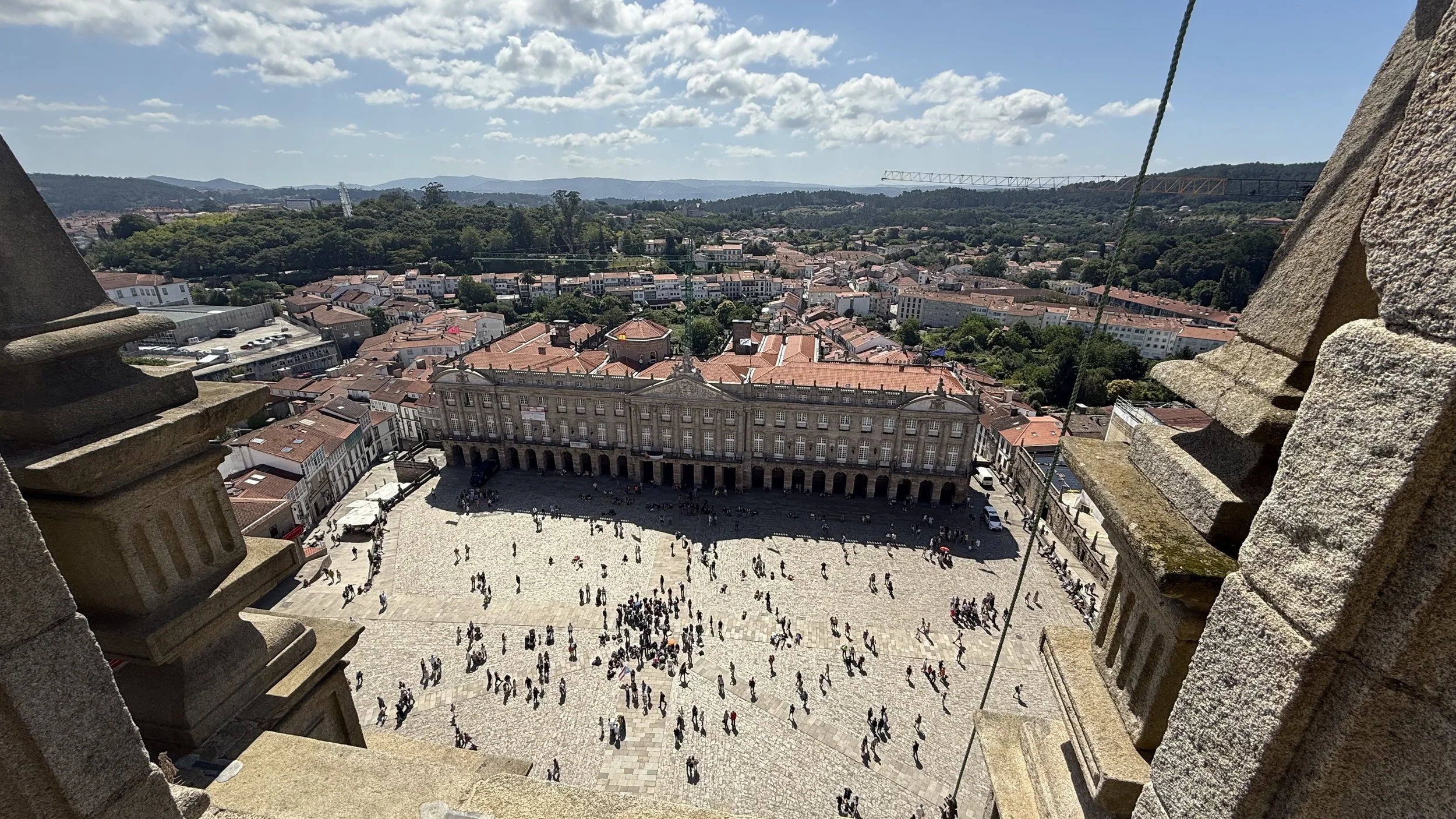
The Praza do Obradoiro, seen from the cathedral roof
Of course, another title for Santiago might be “Eternally Under Construction.” I’ve never not seen its main plaza under renovation— fitting, really, since the Praza do Obradoiro (in English, “Workshop Square”) was named for the stonemasons, carpenters, and glaziers who set up shop there in centuries past. In recent years, the square has lived up to its name as three of its four sides have undergone complete restorations. As I stood taking in the view last week, scaffolding covered the Hostal dos Reís Católicos, the last of the Obradoiro’s façades awaiting a facelift. Hammers pounded out a rhythm that clashed with the melody of the gaita. There was construction inside Santiago’s city hall, too, and a couple of neon vest-clad workers leaned out of a top-floor window, surveying the proceedings below.
I was in Santiago to attend the second edition of Galicia Wine Taste, a fair organized by Galician-born, Swiss-raised Fredi Torres. This year, 67 wineries, mostly from Galicia but with a couple from Bierzo and the rest of Spain, were showing their wines at a hotel connected to a working monastery just outside the old city walls. Fredi was smart to have the fair in Santiago—it’s neutral ground, outside of any wine regions, and easy to get to for the odd Galician wine writer who might fly in for the event.
I got to taste a lot of interesting projects over the course of the day, which I’ll be highlighting in the coming weeks. But what really stuck with me were the parallels between these representatives of Galician wine and the city hosting the fair.
The day I arrived in Galicia, I visited Rodri Méndez in Meaño. We tasted through both his Forjas del Salnés and Rodrigo Méndez wines at A Curva, an iconic restaurant in Portonovo that owner Miguel Anxo Besada has made into a temple of Galician wine. The wines were all fantastic—more to come on that as well—but one part of our conversation encapsulated what I would later feel at the fair.
Tasting Rodri’s red wines, I commented how different they were from when we last tasted through the lineup in 2022. I liked them a lot, but I couldn’t say that they were more or less in line with “typical” reds from Rías Baixas, because no one knows what Rías Baixas reds are supposed to taste like. Their renaissance is so recent that it’s impossible to put them into a box. Rodri and Miguel Anxo both lit up. Yes, they said, that’s the most interesting thing about these wines. We’re finding out in real time what they can do.
I thought about that a lot on this trip. It’s clear that the bar is quite high in Galicia, and there are some really incredible wines being made. But speaking to winemakers about progress, the consensus was “we’ve come a long way, but we have so much more to do.” I think that’s an amazing, humble way of looking at things. The recognition of well-deserved success and the desire for improvement won’t steer them wrong.
Just like Santiago is constantly undergoing a process of renewal and rejuvenation—whether via physical construction or the arrival of new generations—Galician wine is actively under construction. We’re incredibly privileged to be watching this history unfold before our eyes. The last twenty years have seen a leap forward in quality and an explosion of new projects that would have been unimaginable in the last century. And just as Galicia’s capital city has no interest in sitting back and being an idle spectator to eternity, Galician wine is very much not finished evolving.