
Watching the Rain in Galicia
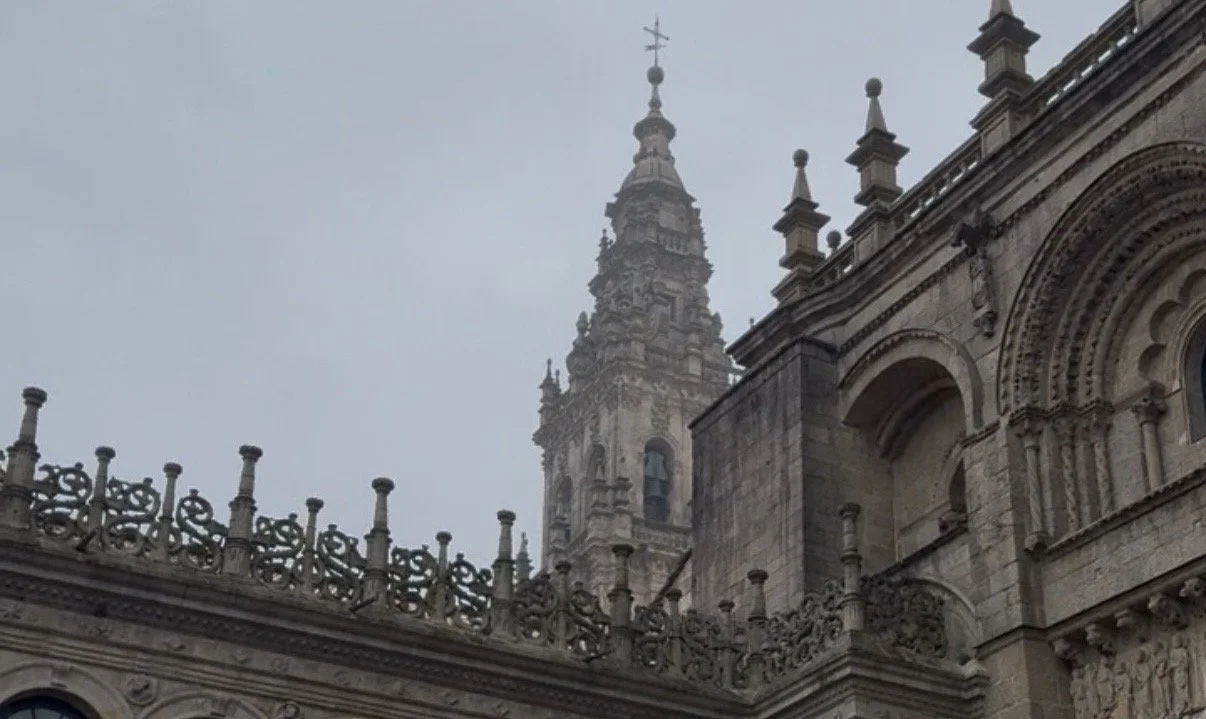
Every time I visit Santiago de Compostela, I’m reminded of the greatest homage to the Galician capital ever written: Viendo Llover en Galicia, or “Watching the Rain in Galicia”, by Gabriel García Márquez—who was of Galician ancestry, of course. I’ve translated it below for your reading pleasure. The original essay can be found here.
Watching the Rain in Galicia
Originally published in El País, May 11, 1983
My very old friend, the painter, poet, and novelist Héctor Rojas Herazo, whom I had not seen for a long time, must have felt a shudder of compassion when he saw me in Madrid overwhelmed by a swarm of photographers, journalists, and autograph seekers. He came over and said to me quietly: “Remember that from time to time you must be kind to yourself.” Indeed, faithful to my determination to satisfy every demand without considering my own fatigue, it had already been several months—perhaps several years—since I had given myself a well-deserved gift. So I decided to grant myself, in reality, one of my oldest dreams: to visit Galicia. No one who enjoys eating can think of Galicia without thinking first, before anything else, of the pleasures of its cuisine. “Nostalgia begins with food,” Che Guevara once said, perhaps longing for the astronomical asados of his native Argentina, while discussing matters of war during the lonely nights in the Sierra Maestra. Nostalgia for Galicia had begun with food for me as well, even before I had ever known the place. The fact is that my grandmother, in the big house in Aracataca, where I met my first ghosts, had the exquisite skill of baking, which she practiced even when she was already old and on the verge of going blind, until a flood destroyed her oven and no one in the house had the heart to rebuild it. But my grandmother’s vocation was so strong that when she could no longer bake bread, she went on making hams. Delicious hams, which we children did not like—because children do not like the novelties of adults—but the taste of the first bite remained forever etched on my palate. I never encountered it again in any of the many and varied hams I ate later in my good years and my bad years, until I happened to taste—forty years later, in Barcelona—an innocent slice of lacón. All the joy, all the uncertainties, and all the loneliness of childhood suddenly returned to me in that flavor, which was unmistakably the taste of my grandmother’s lacones. From that experience my interest in deciphering her ancestry arose, and in searching for hers I found my own in the frenzied greens of May stretching to the sea, in the fertile rains and the eternal winds of the fields of Galicia. Only then did I understand where my grandmother had drawn that credulity that allowed her to live in a supernatural world where everything was possible, where rational explanations had no validity whatsoever. And I understood where her passion for cooking to feed strangers came from, and her habit of singing all day long. “You have to make both meat and fish, because you never know what those who come to lunch might like,” she used to say when she heard the whistle of the train. She died very old, blind, and with her sense of reality completely altered, to the point that she spoke of her oldest memories as if they were happening in that very moment, and conversed with the dead she had known when they were alive in her distant youth. I was telling these things to a Galician friend last week in Santiago de Compostela, and he said to me: “Then your grandmother was Galician, without any doubt, because she was mad.” In truth, all the Galicians I know, and those I saw now without having time to get to know them, seem to me to have been born under the sign of Pisces.
I do not know where the shame of being a tourist comes from. I have heard many friends, in the midst of tourist frenzy, say they do not want to mix with tourists, without realizing that, even if they do not mix, they are just as much tourists as the others. When I go somewhere without having much time to explore it in depth, I shamelessly assume my condition as a tourist. I like to sign up for those quick excursions in which guides explain everything seen through the bus windows, to the right and to the left, ladies and gentlemen, among other things because that way I immediately know everything there is no need to see later, when I go out alone to explore the place by my own means. However, Santiago de Compostela does not allow time for so many details: the city imposes itself immediately, complete and forever, as if one had been born in it. I have always believed, and still do, that there is no square in the world more beautiful than that of Siena. The only one that has made me doubt is that of Santiago de Compostela, because of its balance and its youthful air, which does not allow one to think of its venerable age, but instead seems to have been built the day before by someone who had lost all sense of time. Perhaps this impression does not originate in the square itself, but in the fact that it is—like the whole city, even in its farthest corners—to the very soul a part of everyday life. It is a living city, taken over by a crowd of cheerful and boisterous students who do not give it a single respite to grow old. On the intact walls, vegetation forces its way through the cracks in an implacable struggle to survive oblivion, and at every step one encounters, as the most natural thing in the world, the miracle of blooming stones.
It rained for three days, but not relentlessly, rather with unexpected intervals of radiant sunshine. However, the Galician friends did not seem to notice those golden pauses, and instead constantly apologized for the rain. Perhaps they were not even aware that Galicia without rain would have been a disappointment, because theirs is a mythical land—much more so than Galicians themselves imagine—and in mythical lands the sun never shines. “If you had come last week, you would have found splendid weather,” they told us, embarrassed. “This weather is not appropriate for the season,” they insisted, forgetting Valle-Inclán, Rosalía de Castro, and the Galician poets of all time, in whose books it has rained since the beginning of creation and an endless wind blows, perhaps the very one that sows that lunatic seed that makes so many Galicians different and loving.
It rained in the city, it rained in the intense countryside, it rained in the lake-like paradise of the Ría de Arosa and in the Ría de Vigo and on its bridge, it rained in the impassive and almost unreal square of Cambados, and even on the island of La Toja, where there is a hotel from another world and another time that seems to be waiting for the rain to stop, for the wind to cease and the sun to shine, in order to begin living. We walked through that rain as if in a state of grace, eating by the handful the only shellfish still alive in this devastated world, eating fish that remained fish on the plate and salads that seemed to keep growing on the table, and we knew that all of it was there thanks to the rain, which never quite finishes falling.
Many years ago, in a restaurant in Barcelona, I heard the writer Álvaro Cunqueiro speak about Galician food, and his descriptions were so dazzling that they seemed like the deliriums of a Galician. Ever since I can remember, I have heard Galicians in America speak of Galicia, and I always thought their memories were distorted by the mirages of nostalgia. Today I think of my seventy-two hours in Galicia and wonder whether all of that was real, or whether I myself have begun to fall victim to the same ravings as my grandmother. Among Galicians—as we know—one never really knows.