
Five centuries ago, on an island in the Caribbean, a priest died begging for Galician wine.
Soon after, the man who had crossed the Atlantic three times for the Crown of Castile would be on his way back to Spain, relieved of his command and bound in chains.
And twenty years ago, a chance encounter in a Spanish archive would see the story finally come to light.
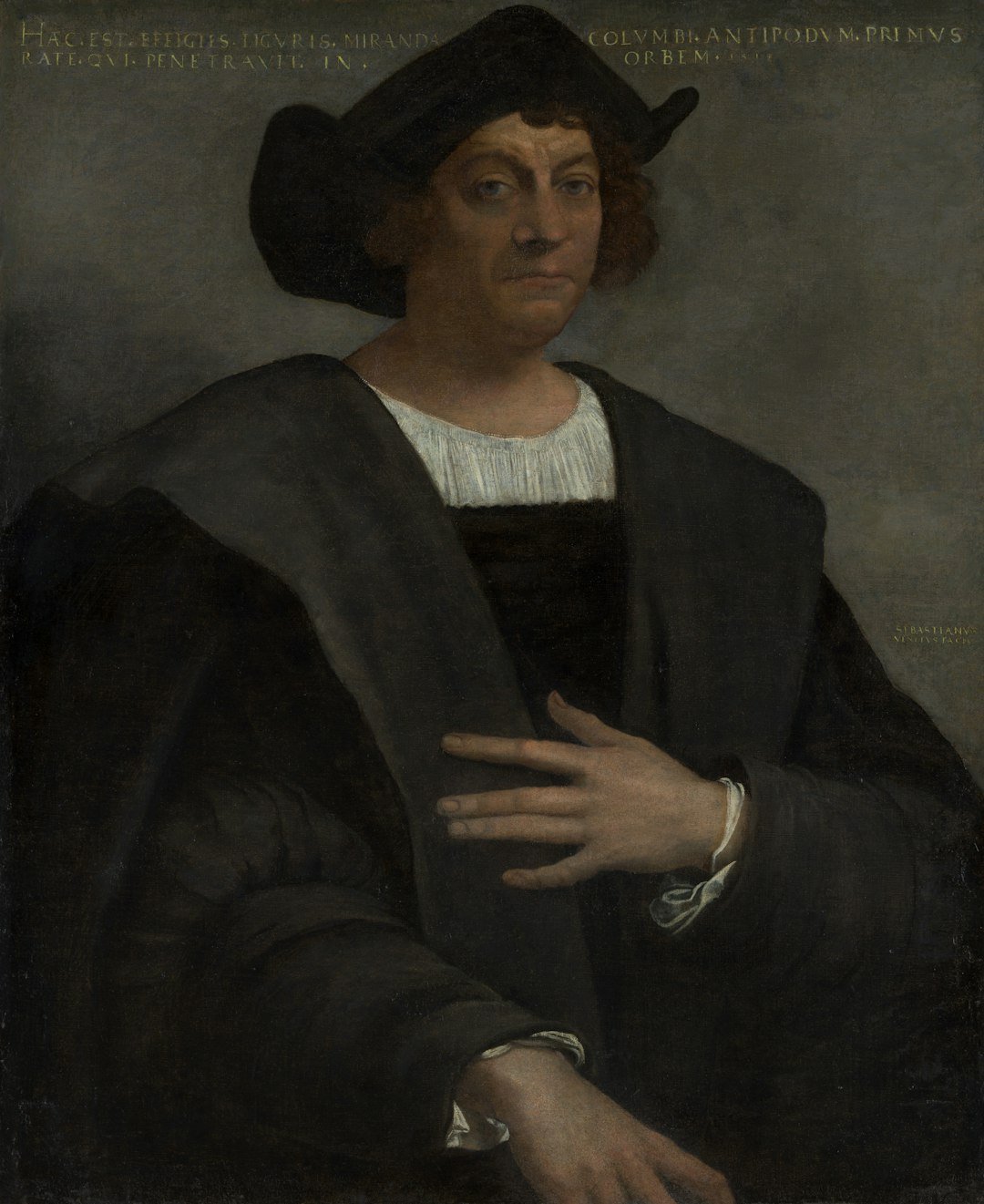
We begin in 1498, when Christopher Columbus finished his third trip to what he still called “Las Indias.” The first had been a voyage of discovery that brought news of a New World back to Spain. The second was a voyage of colonization, undertaken by 17 ships and more than a thousand men. Six years after he first set out in 1492, Columbus was in charge of a fully-fledged colony. Though he was undoubtedly a skillful navigator, Columbus’s skills didn’t extend to land. He was a terrible governor. He was also a terrible person, even by the standards of the time. Intent on finding gold, he and his deputies brutalized the native population, forcing impossible quotas on them and killing those who couldn’t meet them. Spanish colonists didn’t fare much better: Columbus had them paraded naked through the streets, dismembered, or executed as punishment for petty crimes.
Portrait of a Man, Said to be Christopher Columbus by Sebastiano del Piombo, 1519 – Photo by The Metropolitan Museum of Art All of this didn’t go unnoticed. By the time Columbus set off for his third voyage, complaints against him had reached the court of Ferdinand and Isabella, the Catholic Monarchs, in Granada. The rebellion Columbus found upon his return to Hispaniola was the last straw. When Ferdinand and Isabella received a letter from Columbus pleading for help to fight the rebels, they decided to send in their own man. They chose Francisco de Bobadilla, a knight commander of the Order of Calatrava, the military wing of the Cistercian order. He was sent to Hispaniola with orders to investigate Columbus’s wrongdoing. If the reports were confirmed, Bobadilla had the authority to remove the explorer from his post as governor and send him back to Spain.
Suffice it to say things didn’t get off to a very good start. Arriving while Columbus was away trying to put down a rebellion in the countryside, Bobadilla was met with the news that seven Spaniards had been hanged for treason and insurrection, and five more were waiting to swing. A “shoot first, ask questions later” type, Bobadilla wasted no time in storming the garrison where the imprisoned rebels were kept, freeing them, declaring himself governor, moving into Columbus’s quarters and seizing his property, and finally, summoning witnesses to interview them about Columbus’s misdeeds. When Columbus and his brother returned, Bobadilla had them arrested and shackled, then immediately began the preparations to send them back to Spain.
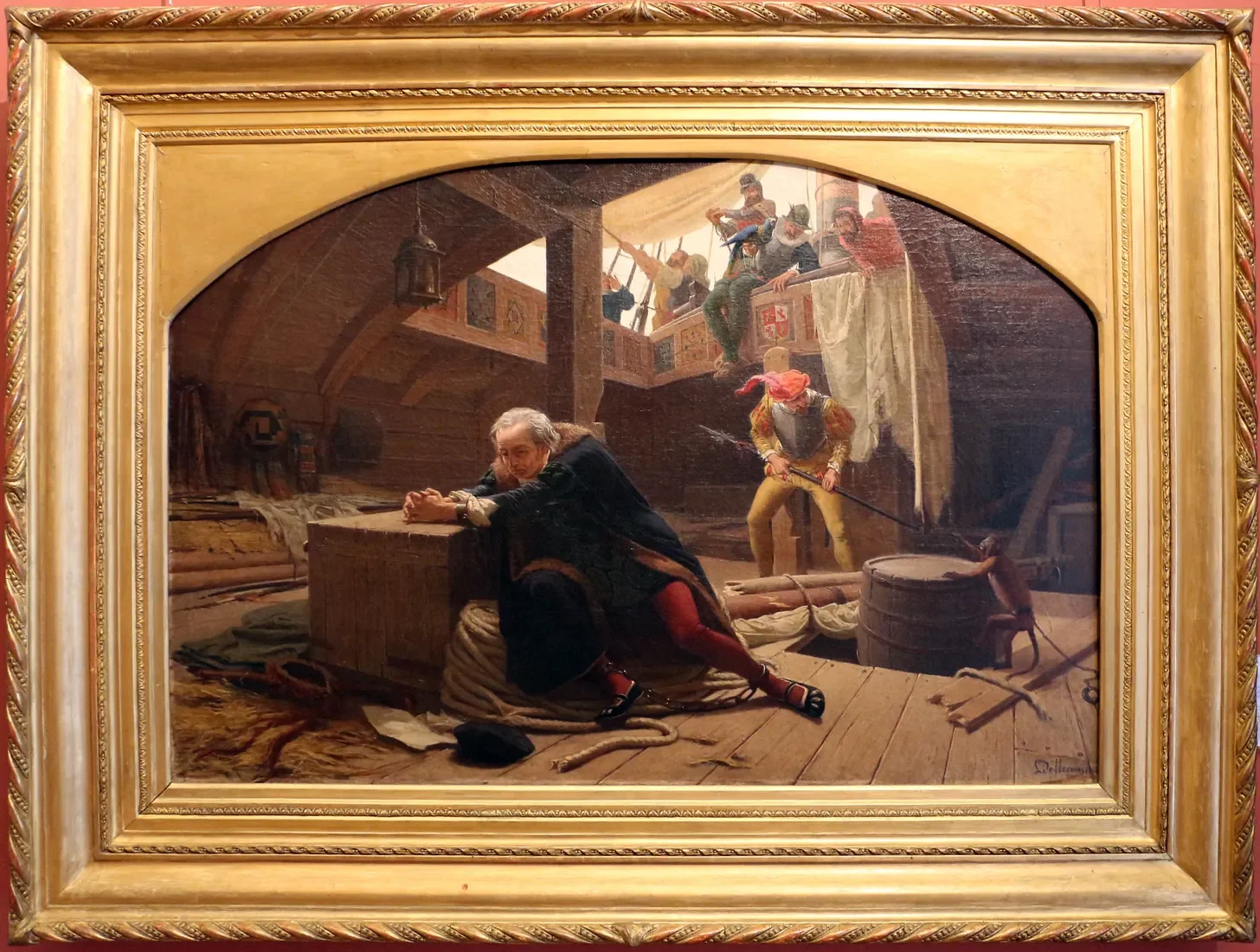
Lorenzo Delleani - Christopher Columbus returning from the discovery of America (1863)
Traveling with them was the result of Bobadilla’s investigation: a lengthy report of the explorer’s crimes, propped up by the accounts of the witnesses Bobadilla had interviewed. The ship landed at the port of Cádiz in November 1500, but the Columbus brothers would languish in jail for six weeks before Ferdinand and Isabella summoned them to Granada.
The canny Genoese had refused to remove his chains during the entire voyage, even when the ship’s captain had offered to remove them. Wearing a short-sleeved Franciscan’s tunic, he threw himself at the mercy of Queen Isabella, weeping and repenting of his crimes. It worked. Moved by his story, the monarchs ordered Columbus to be freed from jail and his property restored to him. But if the explorer thought a complete pardon was in store, he was soon disabused of the idea. In punishment for his crimes, the sovereigns stripped Columbus of his titles, the profits of his voyages, and the governorship of Hispaniola, all of which he would spend the rest of his life unsuccessfully trying to reclaim.
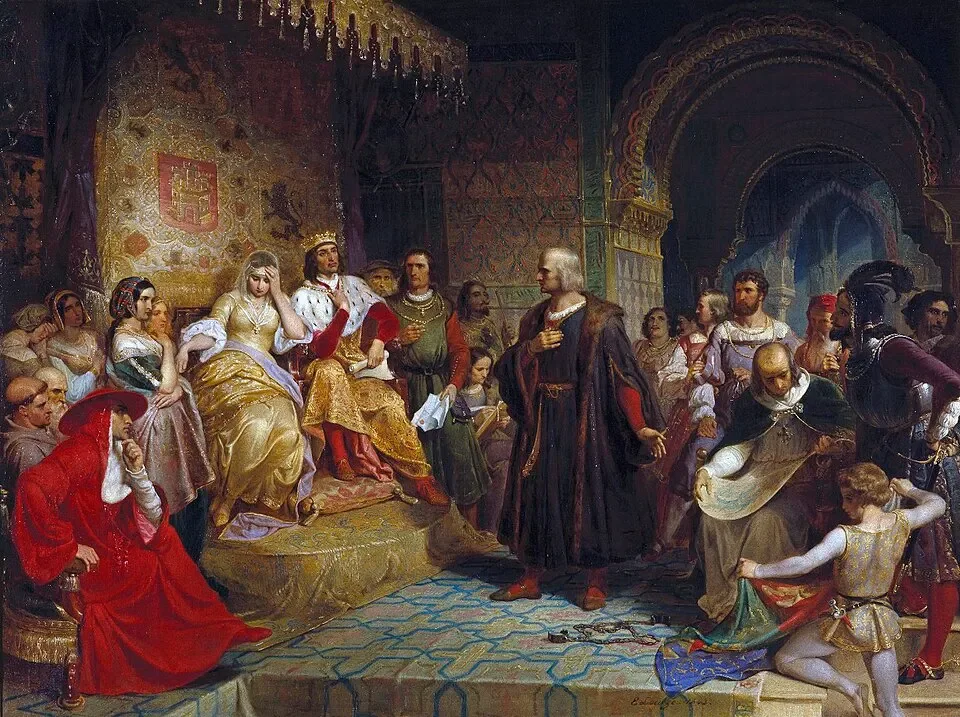
“Columbus Before the Queen” by Emanuel Leutze, 1843
Five centuries later, historian Consuelo Varela was waiting for a file she had requested from the Archivo General de Simancas when Isabel Aguirre, the head archivist, approached her. Aguirre was smiling, as she always did. She had just come across a document in one of the files, she explained, that looked particularly interesting. She wanted Varela to have a look at it and, if she thought it warranted further attention, to study it. She handed her a copy of the transcription she had made and returned to her desk.
Varela would later write that she could scarcely describe the emotions that passed through her as she read the manuscript. What she held in her hands was nothing less than a copy of Bobadilla’s inquiry, thought to have been lost for five hundred years. Its significance was difficult to overstate: this was the very document that had led to Columbus’s removal from office and his return to the Iberian Peninsula in chains.
Over the next several months, Varela and Aguirre would transcribe the report and eventually publish it as “La caída de Colón: El juicio de Bobadilla” or “The Fall of Columbus: The Judgment of Bobadilla.” The report was a litany of complaints against Columbus: he was tyrannical, he was cruel, he was greedy… but hidden among them was the detail that interests us: the first documented reference to wine in the New World.
The eighth witness to give his deposition was a man named Juan de Salaya, who worked at the provisions storehouse. Salaya didn’t have a complaint himself, but rather spoke on behalf of those who had died as a result of Columbus’s miserly treatment of the rations. In his second testimonial, he says that “a Galician cleric had one or two casks of Ribadavia wine taken from him, and that, while he was ill, he asked for an arroba or two of wine because the ration they gave him was insufficient for his illness, but they refused to give it to him. The witness saw him die while asking for the said wine.”
Ribadavia wine! The only wine to be cited by name in the document came not from Jerez or Castile, but from Galicia. This was what we know today as Ribeiro, although it was more commonly referred to as Ribadavia at the time as a nod to the regional capital.
Who was this Galician priest, also referred to as an abad, or abbot, by another witness? Did he have any connection to the Ribeiro region? And what was he doing with so much wine?
According to the provisions of the Royal Ordinances of 1562, each pipa held about 240L, but there was also another type of pipa in use at Columbus’s time that held twice as much! Regardless, the priest asked for an arroba or two of wine—the arroba was equivalent to about sixteen liters.
As literature professor Ángel Gómez Moreno dryly notes, “this unnamed Galician cleric must, therefore, have been very fond of wine.”
Moreno continues:
“He must also have had great faith in its ability to restore lost health, by providing the body with energy and lifting the spirits (hence the Latin maxim bonum vinum laetificat cor hominis, “good wine gladdens the heart of man”) and, in the case of Ribadavia wine, because it was regarded as medicinal in its own right. In this regard, one need only read Luis Lobera de Ávila’s Banquet of Noble Gentlemen (Banquete de nobles caballeros, 1530), specifically Chapter XI, entitled On Wines and Their Harms and Benefits, and Their Temperaments: “The white wines of Ribadavia, Yepes, Madrigal, Simancas, Medina del Campo, Valladolid, Villafranca, Monviedro, Orense, Martos, and Ciudad Real, provided they have not been adulterated, are medicinal.”
But the priest’s faith in his wine never bore fruit. Another witness, Diego de Escobar, confirms Salaya’s version of events:
“…he states that [Columbus] took two casks of wine from Alonso de Salamanca, and likewise took two and a quarter casks from a Galician abbot. They asked him many times to return the wine, or at least some portion of it, because they were very ill, but he refused to give them any of it. They died of that illness; and, as far as he could judge by ordinary reasoning, they would not have died had they been supplied with the provisions from their own property.”
Why did Columbus withhold the wine? Was he hoarding it away for himself, as other witnesses from the investigation seem to suggest? Did he feel trapped into setting a precedent for his men? Varela and Aguirre don’t venture any guesses in their analysis, limiting themselves to writing that the Galician cleric may have been Brother Juan de Caicedo, a Galician friar whom several witnesses mentioned, but who had died by the time the depositions were taken. He accompanied Columbus on his third voyage to the New World, with a salary of 20 maravedís.
“The friar had no qualms about setting out with his purse well stocked,” they write, “as evidenced by the fact that the merchant Antón Mariño collected 3,600 maravedís in advance from his wages when he embarked.” Could this have been for a couple of casks of Ribadavia wine, as the authors seem to imply? It’s not impossible.
Beyond the revelation of the first documented reference to wine in the Americas, this little footnote in the larger story of colonization and the Columbian Exchange leaves more questions than answers. We’ll probably never know who the man really was, whether he came from the vineyards of Galicia, what possessed him to carry so much wine across the Atlantic, or why Columbus denied him the thing he believed might save his life. But thanks to that chance discovery in the archives, we know at least this much: somewhere on Hispaniola five centuries ago, a dying man called out for the taste of home, and the wine he begged for was from Ribeiro.