
In 2014, researchers from the Misión Biológica de Galicia visited 54 churches across Galicia’s winegrowing regions as part of a groundbreaking study combining art history and ampelography. They were on the hunt for Solomonic columns: the twisty-turny, corkscrew-shaped columns characteristic of the Baroque period of religious architecture. Having seen quite a few of them decorated with grapevine motifs, the researchers suspected that the artists who carved the 17th-century columns had probably used real models.
When they compared the carved grapes with modern-day varieties, the results confirmed another long-held suspicion: Galicia’s traditional grapes have been around for a long time. The 300-year-old carvings depicted varieties such as Albariño, Dona Branca, Loureira, Castañal, and Brancellao in incredible detail, right down to the number of lobes on the leaves and the shape of the bunches.
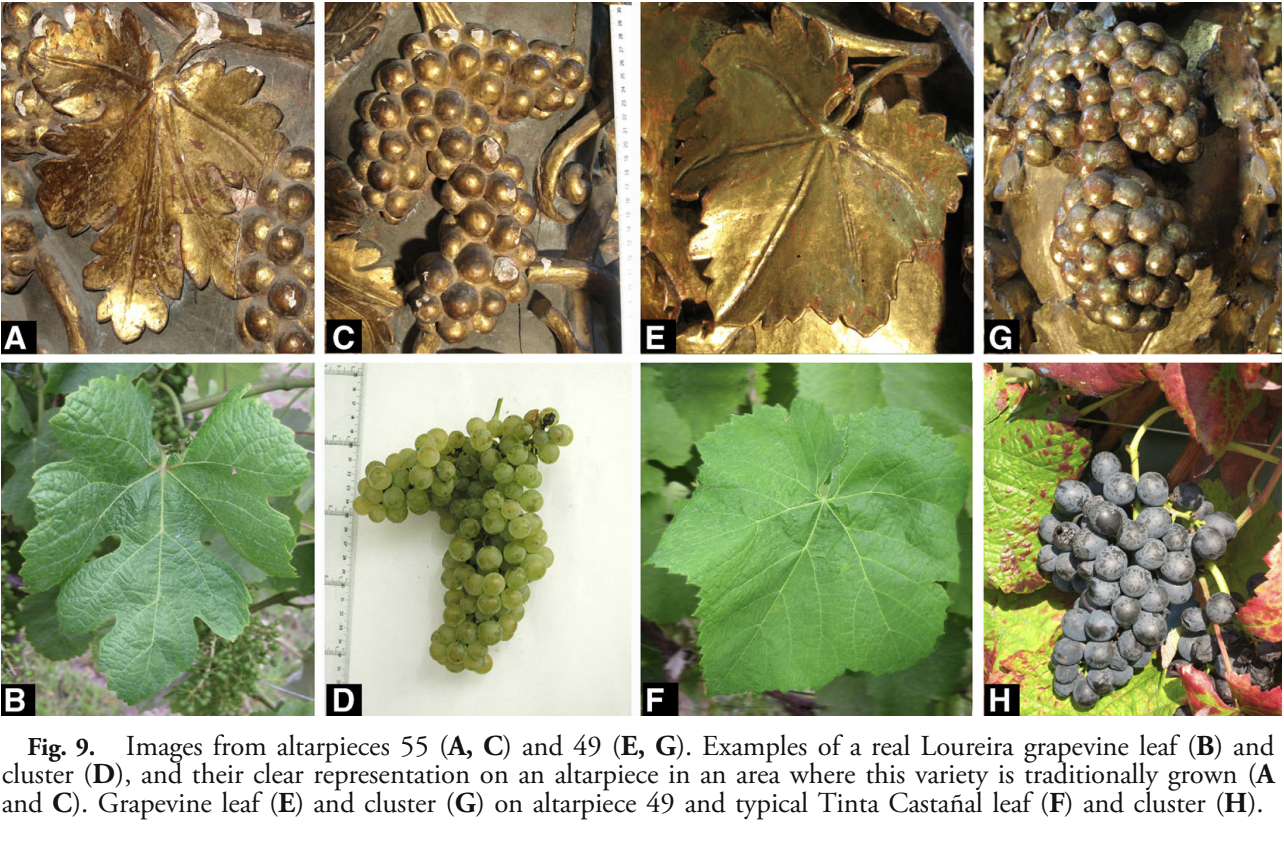
from Gago, P., S. Boso, V. Alonso-Villaverde, J. L. Santiago, and M. C. Martínez. “Works of Art and Crop History: Grapevine Varieties and the Baroque Altarpieces.” Economic Botany 68, no. 2 (2014): 153–168.While it’s impossible to know whether the exact vines those master carvers modeled have survived to this day, incredibly enough, some of their contemporaries definitely have. Although the title of oldest single vine in Galicia is difficult to narrow down, the region is home to quite a few vineyards that predate phylloxera, and even to a few incredible plots that were planted over two centuries ago.
Paradoxically, many of these old vines are concentrated in an appellation whose success has come from producing young wines that are largely consumed within a year of bottling: Rías Baixas.
And within Rías Baixas, some of the best examples of old vines are farmed in one village by different branches of the same family. Rodri Méndez of Forjas del Salnés and his cousin Manu Méndez of Bodegas Gerardo Méndez (Do Ferreiro) are tied for the oldest vineyards in Rías Baixas: both of them farm 200+ year-old plots of Albariño in the village of Meaño. Nearby, another cousin, Pedro Méndez, recently began making wine under his own name and has also acquired century-old parcels. As it happens, Manu’s and Rodri’s wines are consistently rated by critics as some of the most complex, age-worthy wines in Rías Baixas, and from what I’ve tasted it doesn’t seem like Pedro is far behind.
I asked them about this chicken-or- egg dilemma that comes up again and again in the wine world when we talk about old vines: did they survive because they’re better, or are they better because they survived?
Do old vines automatically make better Albariño, or is it just that top winemaking talent is uniquely capable of coaxing the best from them?
For Manu Méndez, the answer is clear: “If the age of the vineyard alone were what determined wine quality, then it would simply become a competition to see who has the oldest vines,” he says. We’re standing in the family’s oldest vineyard, a 200-year-old marvel of gnarled trunks that seem to sag a bit under time’s weight. The Méndez family has been vinifying this plot separately since 1995 to make their flagship wine, called Cepas Vellas or “Old Vines” in Galician.
What’s truly important is terroir, Manu tells me. He turns to the example of France: if a Grand Cru vineyard is replanted, it doesn’t stop being a Grand Cru. “Why? Because the concept of terroir is more important than the age of the vines themselves,” he says. “Having old vines in poor terroir just means you have old vines. But if you have old vines in great terroir, then you’re more likely to produce a better wine.”
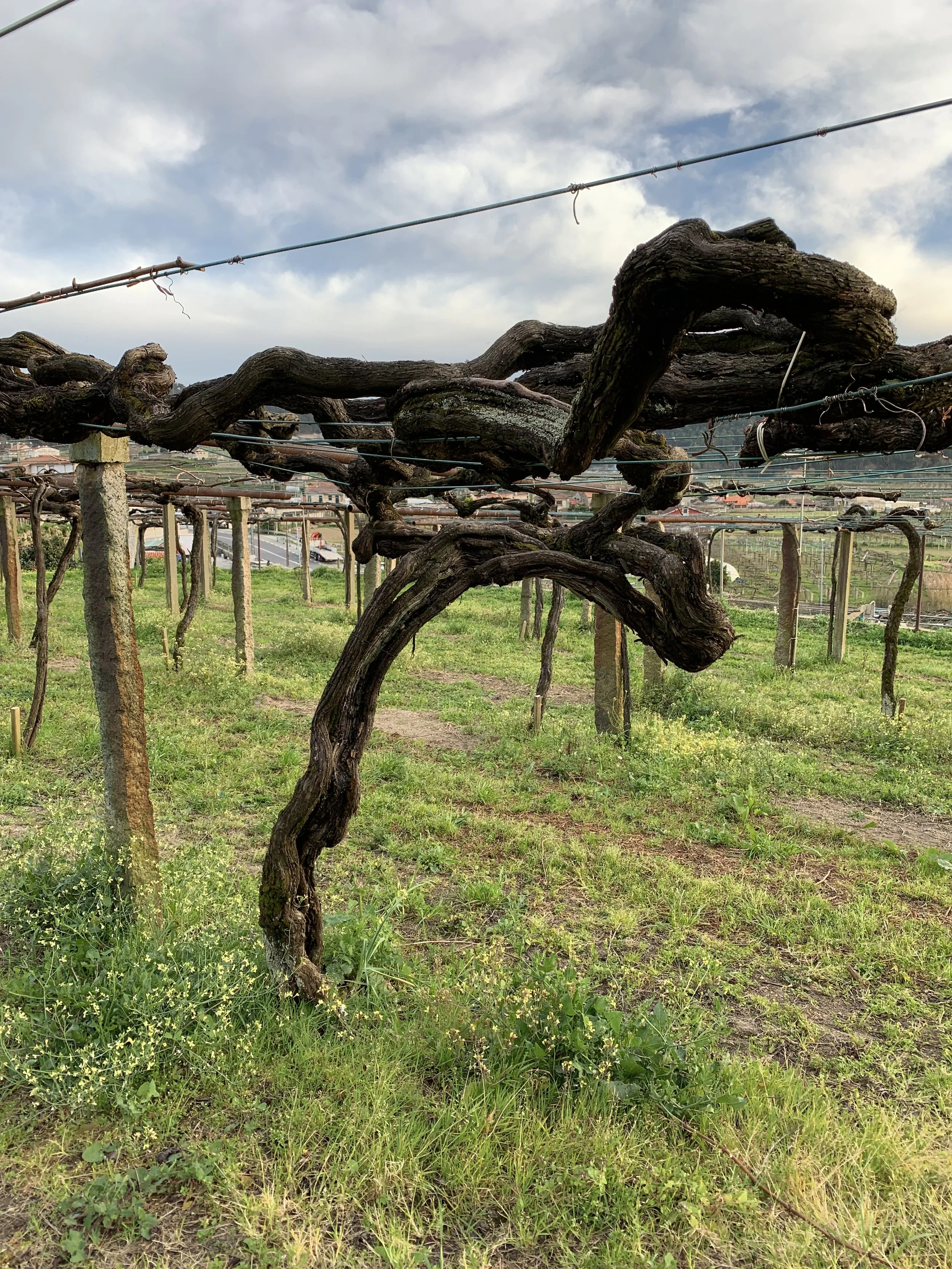
A 200+ year-old vine in Bodegas Gerardo Méndez’s Cepas Vellas vineyardIt’s not just the soils, either, as the human element has an important role to play. “Terroir is the combination of location, topography, exposure, and the work of the person who cares for the vineyard and ultimately makes the wine,” Manu says. “The producer is part of the whole picture. It’s all interconnected.”
A few days earlier, I watch his cousin Rodri Méndez put his hand through the cracked-open trunk of a vine that easily reached three meters in height—At what point does a vine become a tree?—and admit that he has no idea how the thing is still alive. “This speaks for itself,” he says. “These are picture-perfect examples of the old vines we have here. According to the owners, these could be 300 years old.” Unlike his cousin, Rodri uses a significant part of his old vines in his youngest cuvée, Leirana. He believes the structure they give is invaluable to the youngest wine in the lineup—“which doesn’t make it any less important,” he says.
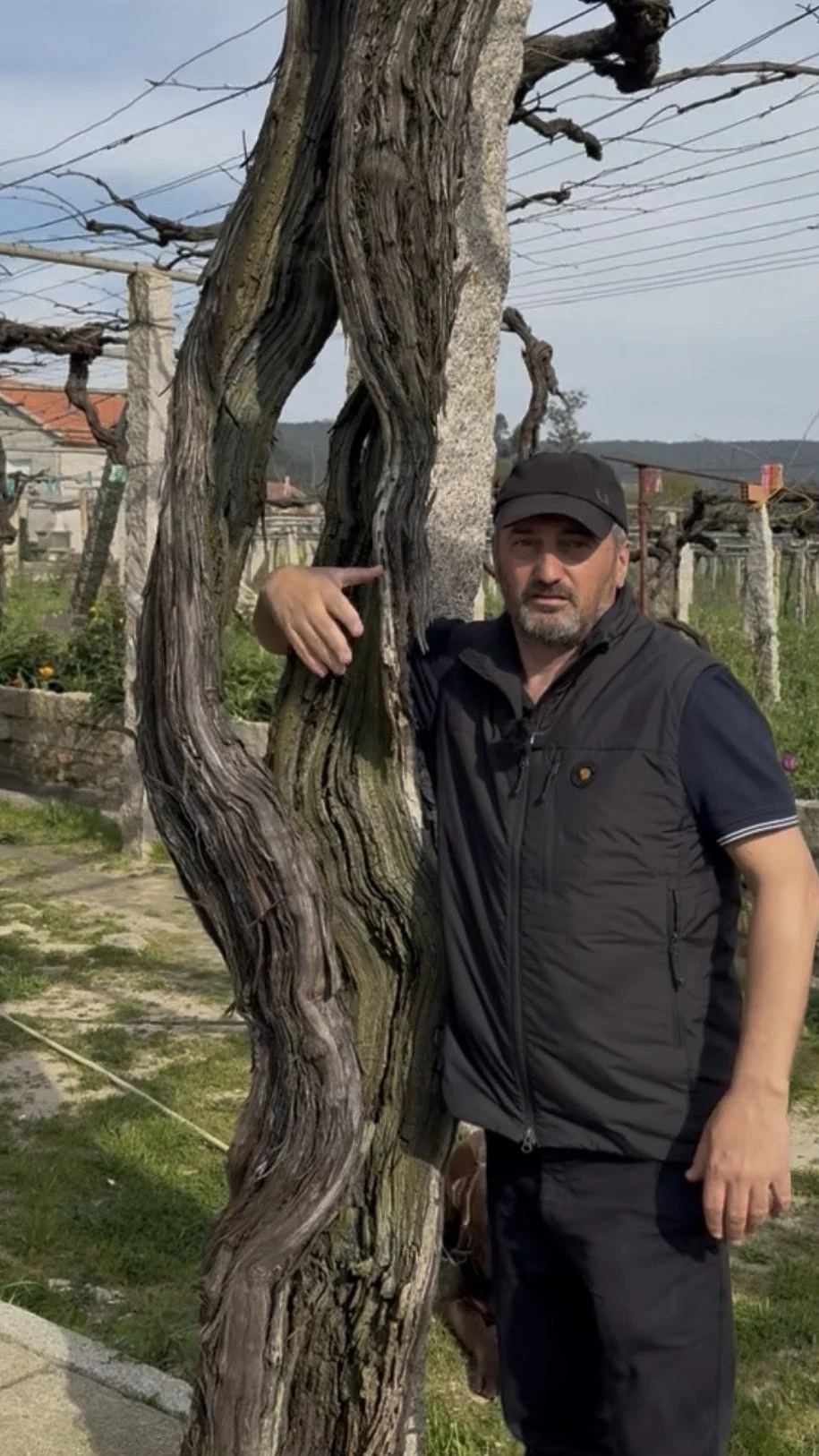
Rodri Méndez of Forjas del Salnés with a vine believed to be 300 years oldHis take is similar to Manu’s: simply put, old vines don’t guarantee a good wine. But he does believe in the importance of the “primitive clone” of Albariño.
Where today you might see newer plantings with large clusters and large grapes, in the past, Albariño clusters were smaller, with smaller berries packed more tightly together. Rodri uses this Ur-Albariño to replant vineyards via massale selection, as he believes in its potential to make the kind of concentrated, age-worthy wine he wants to make. He looks at this work as a continuation of something that was begun a long time ago, and that will hopefully continue for a long time in the future.
Much like those Baroque altarpieces, Galicia’s old vines have survived to the present day thanks to a combination of artistry and faith. But the most remarkable thing about them is that nobody set out to save them.
They survived because they belonged to a way of life in which nearly every household had its own plot of vines that was lovingly cared for like another member of the family. Instead of an asset to be replaced when its production fell, what we now see as a viticultural treasure trove was once just part of everyday life.
We’re in Paradela, a small corner of the parish of Lores, within the village of Meaño. (In Galicia, everything gets a name.) As we drove to this vineyard, Rodri told me that old, pre-phylloxera vines can be found at almost every house in Meaño. In the 1970s, most people were cosecheros—growers who made their own wine—so almost everyone had their own vines. Some of those cosecheros joined DO Rías Baixas when it was first established, but the requirements for upgrading their facilities proved difficult, especially since many of them were older people, so their participation was short-lived. After a few years, they decided to leave the DO and continue as independent growers, and today, much of the village is still home to the old vines they cared for.
Another reason old vines survived here was the lack of concentración parcelaria, a land consolidation scheme first introduced in the 1950s and expanded during the ‘60s and ‘70s as Spain pursued agricultural modernization. The process consisted of putting together fragmented smallholdings into larger, more accessible parcels to make them easier to work. Meaño underwent relatively little concentración parcelaria, which means that the minifundio, or smallholding, system is still alive, and each owner continues to care for their own old vines.
But when the owners are unable to care for them anymore, they sometimes look for someone who can. Someone like Pedro Méndez, Manu and Rodri’s cousin and the newest member of the family to enter winemaking. Pedro didn’t inherit any particularly old vineyards, but rather came into contact with them after he began leasing land and looking for new parcels. For him, carrying on the work of past generations is a huge responsibility.
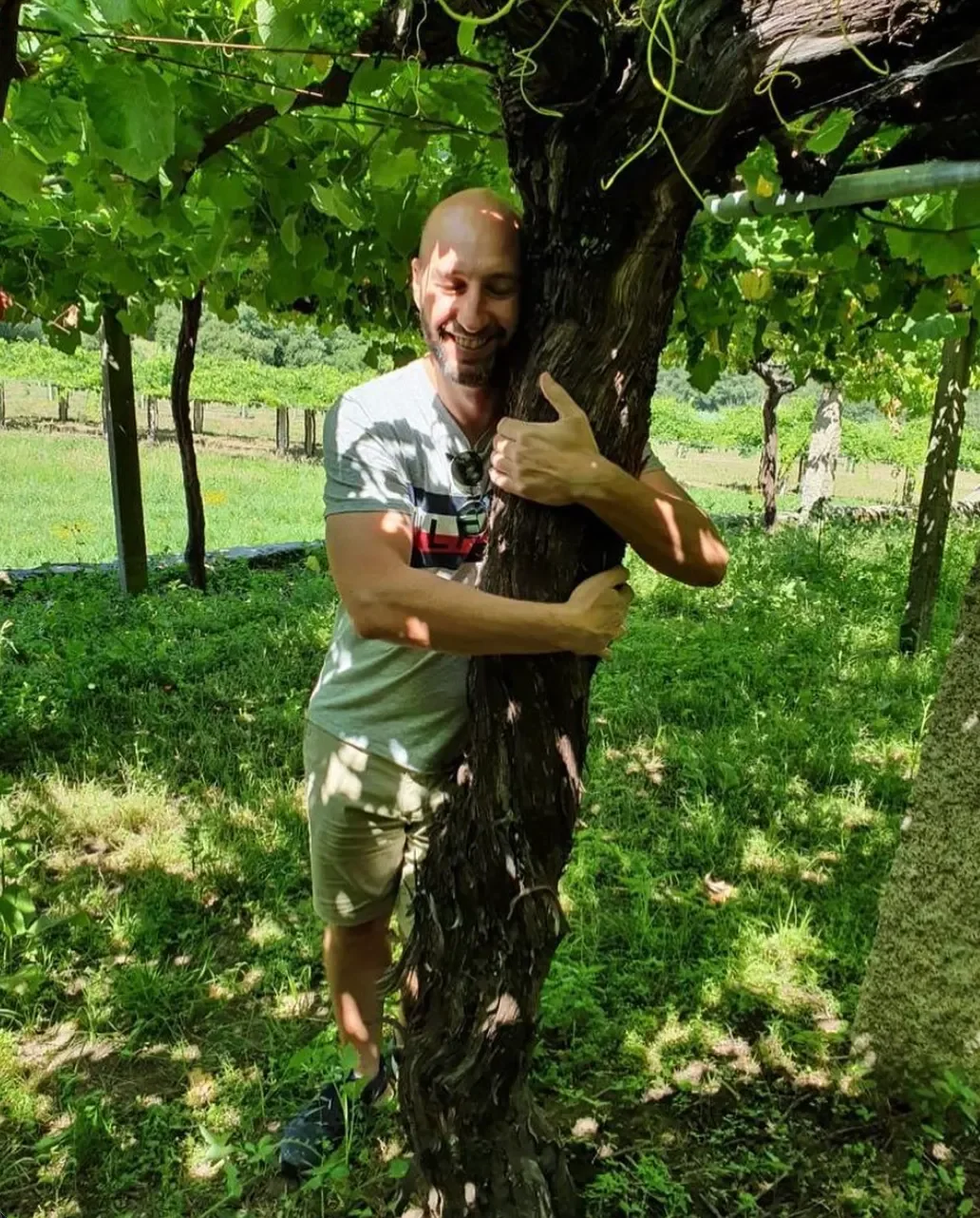
Pedro Méndez, photo from his Instagram“It’s something I approach with great respect,” Pedro says. “I consider myself very fortunate. Being able to continue the legacy of growers who planted these vines more than a hundred years ago, in a time and historical context that was completely different from the one we live in today, is a real privilege.”
His wine “Tres Vellas” is made from three parcels of vines averaging 80 to 100 years old, but he guesses some of the individual vines he farms are nearly 200 years old.
Pedro thinks old-vine Albariño makes better wines. Or not. Here comes the Galician aversion to straight answers: “Well, I wouldn’t say better, because one doesn’t diminish the other,” he backpedals. “What I do believe is that old vines make wines that are more complex and more complete, so to speak.”
When we talk about Albariño, he explains, we often think of fresh wines with medium alcohol, good acidity, and a lighter, more citrus-driven profile. But when we talk specifically about Albariños from old vines—and when winemakers know how to guide the fruit through the winemaking process—it becomes clear that old vines produce a more complex and profound wine that tends to age in a way that newer vines simply don’t.
This lines up with what Manu tells me as well. Although terroir is the most important factor, old vines just have that X-factor, he admits. From a technical point of view, wines made from old vines have higher acidity, lower pH, and lower alcohol. But because the root system is often quite damaged, he explains, the wines tend to have a much higher dry extract, which gives them greater structure and substance.
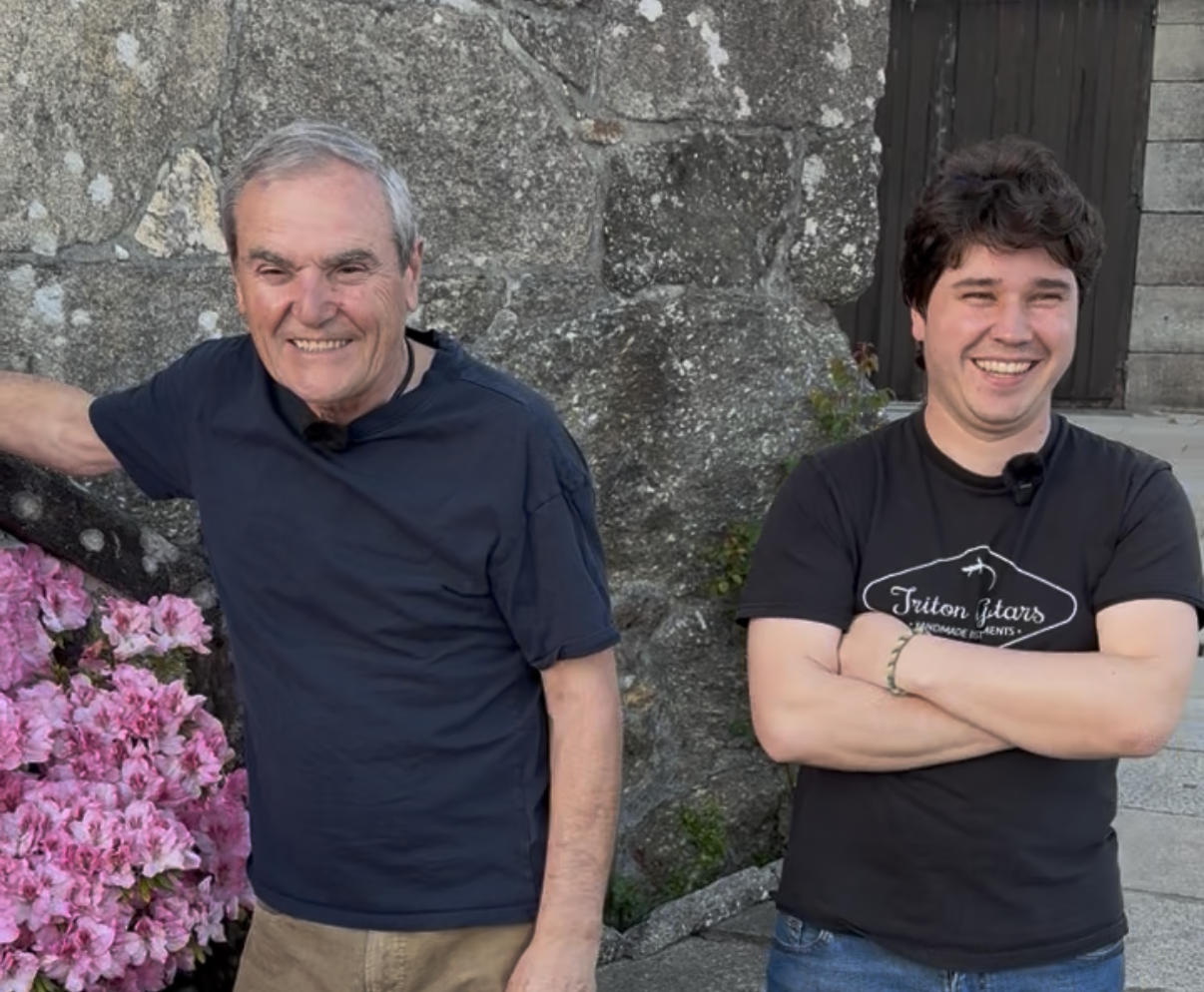
Manu (right) and his father, Gerardo MéndezNot that he read that in a textbook. When you work with old vines, especially in Rías Baixas, there’s no viticulture manual for producers to rely on. Very little has been written about old vines, so the only choice has been to learn on the go. “You learn how a grape variety behaves and how vineyards were managed over a century ago,” Manu says. You come to understand the variety itself from a viticultural perspective: its vigor, how pruning had to be carried out, the way things were done in those times. Being able to own and work with very old vineyards is like having access to a living historical museum,” he tells me.
Looking out from the Cepas Vellas vineyard over the valley, you realize how privileged he is to be able to come to work in this museum day after day. Manu could show off this vineyard to the world and try to become some winemaker-cum-old vine influencer, but he doesn’t. He chooses to let the wines speak for themselves, preferring to take center stage as the guitarist of his rock band instead of trying to find fame from the vineyard.
“If, as a winemaker, you want to be the protagonist of a wine made from old vines, I think that’s a mistake,” Pedro says. “I don’t think there’s much of a point in making wine from old vines if you’re then going to intervene excessively and distort the character of that raw material. If you have first-class fruit, then that should be the one speaking and showing what it can offer.”
It’s a beautiful idea: a conversation between two centuries. These producers are custodians of this museum, taking the wisdom of their ancestors, applying it to the vines they’ve inherited from them, and then letting the old vines speak.
But for all their extraordinary longevity, old vines aren’t invulnerable. Pedro has begun noticing older plants succumbing to wood diseases and struggling through summers that are only getting hotter and drier. “Every time an old vine dies, it genuinely causes me a great deal of frustration,” he says. “Like all living things, I understand that vines have a beginning and an end. But still, it upsets me.”
What’s more, the Albariño boom over the past decade has seen new plantations pop up all over Rías Baixas, meaning the overall proportion of old vines has become much smaller. As both Albariño’s popularity and the size of new vineyards have grown, the conditions that allowed these ancient vineyards to survive have become less representative of the region’s future. It’s natural to see more and more young vineyards being planted to maintain the balance between supply and demand. But a new planting, even in the best terroir under the best conditions, can’t replace what takes centuries to develop.
“I always say that, although I’m planting vineyards myself, you can’t plant old vines,” says Pedro. “I’d love for all my vineyards to consist of old vines, but that’s not something within my control. What is within my control is collecting cuttings from old vineyards and propagating vines from those ancient clones so that we can continue preserving that lineage of Albariño.”
“The trend is to continue making young wines, and that’s not necessarily a bad thing,” Manu says. “In the end, these are the wines that drive the economy of any wine-producing region. If that base doesn’t work, we can’t expect to make more special wines. But having old vineyards means they’ve been deeply rooted in our culture for many years, and that we continue to preserve that tradition. We’re still maintaining the tradition. I think that’s a very telling and very positive sign that things are still being done properly.”
Or, as Rodri says: “I always say we can’t invent anything. We can only continue the work that was begun by our ancestors.”